UN Tourism

Where will AI send travellers next, and who gets to decide?

As travellers increasingly rely on artificial intelligence to decide where to stay, what to see and where to go, the technology is reshaping how destinations are discovered and experienced. World Tourism Day 2026 puts this transformation centre stage in El Salvador, where tourism meets the global conversation on AI governance. The event explores how emerging technologies can create new opportunities for destinations, businesses, governments and tourism workers, while helping to build a shared vision for the sector’s digital future.

World Tourism Day, observed since 1980, exists to make the world see what tourism is worth.
Photo:UN Tourism
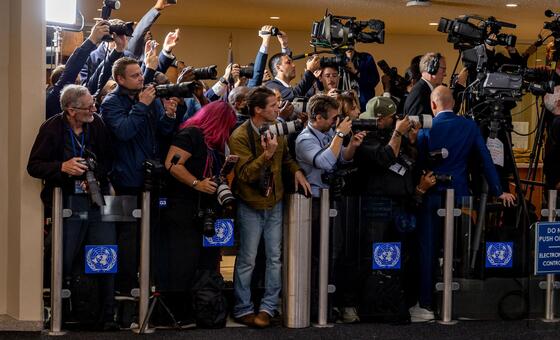
Photographers and video journalists with cameras and telephoto lenses crowd a press pool barrier at the United Nations headquarters in New York as delegates and heads of state arrive.

The Takeaway: UN General Assembly debate Day 5

27 September 2026 — From artificial intelligence to migration, some of the forces reshaping the twenty-first century took centre stage at the UN General Assembly on Saturday. Leaders wrestled with...

Countries adopt global blueprint to tackle fast-evolving crime in digital age

26 September 2026 — Countries adopted on Saturday a new global blueprint for tackling rapidly evolving forms of crime, as the UN’s largest gathering on crime prevention and criminal justice opened...

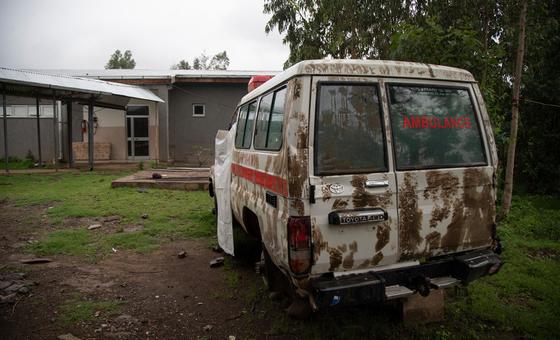
UN voices grave concern as fighting spreads across northern Ethiopia

25 September 2026 — The UN said on Friday it remains gravely concerned by the continued deterioration of the security situation across northern Ethiopia, as fighting spreads across multiple fronts...

UN Sustainable Development Goals

17 Goals to transform our world

The Sustainable Development Goals are a call for action by all countries — poor, rich and middle-income — to promote prosperity while protecting the planet.

hands holding megaphone and speech bubble

The Goals can improve life for all of us. Cleaner air. Safer cities. Equality. Better jobs. These issues matter to everyone. But progress is too slow. We have to act, urgently, to accelerate changes that add up to better lives on a healthier planet. Find new inspiring actions on the app and at un.org/actnow.

Today, half the world is under 30, and this generation is a powerful force for peace. The UN "Hear Us. Act Now for a Peaceful World" campaign, launched on the International Day of Peace, aims to include, invest in, and partner with young people to build lasting peace. 

the UN Secretariat building with country flags, surrounded by colors of the SDGs

Watch our live broadcast of the SDG Media Zone during this year's high-level week from 21-25 September. Discover the transformations, innovations, and global solutions required to accelerate progress on the SDGs. Check out our daily Pulse blog for highlights of the conversations.

SDG logo in General Assembly hall

As world leaders gather for the 81st session of the United Nations General Assembly, the task is clear: to put the Sustainable Development Goals at the centre of global decision-making. Read more in the Goal of the Month editorial. 

More from the
United Nations

Featured stories from across the United Nations and our world-wide family of agencies, funds, and programmes.

the scales of justice on a digital background International Law and Justice, UNODC

Justice for People and Planet in the Digital Age

As technology transforms our lives, it is also reshaping crime — and challenging how justice systems respond. From 26 September to 1 October, the 15th UN Crime Congress in Abu Dhabi brings together governments, civil society, academia and experts to explore how criminal justice can keep pace with rapid technological change. Discussions will focus on protecting people, especially the most vulnerable, and the environment from crime, violence and exploitation. From access to justice and smarter prevention to stronger partnerships and emerging forms of crime, the Congress will seek practical solutions for a safer, fairer digital age.

two photos: smiling child and woman stacking boxed pastries Economic Development, UNDP

Moving beyond crisis

Surviving a crisis is only the beginning. A child still needs a school, a farmer safe land and a family a place to call home. Yet more than 160 million people lack the support they need to rebuild their lives. UNDP is working to close the gap between emergency relief and long-term recovery, restoring services and livelihoods while crises are still unfolding. From clearing dangerous land in Ukraine and Syria to supporting businesses in Afghanistan and housing in Gaza, the goal is to help communities regain stability, rebuild local economies and prepare for a future beyond crisis.

children's panel on a podium Éducation, Children, Human Rights

Children want a say in their education

Children are calling for a greater say in decisions about their education. At a UN Human Rights discussion on the right to education, young participants highlighted barriers that continue to exclude children from learning and stressed the need for education systems that respond to different needs and circumstances. Inclusive education requires more than access to a classroom: it means removing discrimination and other barriers, providing appropriate support and ensuring children can participate in decisions that affect their learning.

Migrants, IOM

Returning to give back

After years of displacement, Professor Emile returned to Rwanda, using his medical expertise to rebuild healthcare, train doctors, and strengthen communities.

SDG 8: Decent Work and Economic Growth, ILO

A new beginning

After fleeing Sudan, Alhassan rebuilt his livelihood in Egypt, growing his business through training while supporting his daughter’s life-saving leukemia treatment.

Climate, Agriculture and Food, IFAD

Building farm resilience

Forecast-based action, resilient crops, efficient irrigation, diversification, and integrated support systems help farmers withstand El Niño shocks and strengthen long-term food security.

Peace and Security, UNCTAD

Gaza’s recovery challenge

UNCTAD estimates Gaza needs $71.5 billion for recovery as economic collapse, damaged infrastructure, fiscal pressures, and widespread unemployment deepen humanitarian and development challenges.

What we do

Due to the powers vested in its Charter and its unique international character, the United Nations can take action on the issues confronting humanity in the 21st century, including:

Structure of the
United Nations

The main parts of the UN structure are the General Assembly, the
Security Council, the Economic and Social Council, the Trusteeship Council, the International Court of Justice, and the UN Secretariat. All were established in 1945 when the UN was founded.

The General Assembly is the main deliberative, policymaking and representative organ of the UN. All 193 Member States of the UN are represented in the General Assembly, making it the only UN body with universal representation.

The Security Council has primary responsibility, under the UN Charter, for the maintenance of international peace and security. It has 15 Members (5 permanent and 10 non-permanent members). Each Member has one vote. Under the Charter, all Member States are obligated to comply with Council decisions.

The Economic and Social Council is the principal body for coordination, policy review, policy dialogue and recommendations on economic, social and environmental issues, as well as implementation of internationally agreed development goals.

The Trusteeship Council was established in 1945 by the UN Charter, under Chapter XIII, to provide international supervision for 11 Trust Territories that had been placed under the administration of seven Member States, and ensure that adequate steps were taken to prepare the Territories for self-government and independence.

The International Court of Justice is the principal judicial organ of the United Nations. Its seat is at the Peace Palace in the Hague (Netherlands). It is the only one of the six principal organs of the United Nations not located in New York (United States of America).

The Secretariat comprises the Secretary-General and tens of thousands of international UN staff members who carry out the day-to-day work of the UN as mandated by the General Assembly and the Organization's other principal organs.

Learn more

Podium of the General Assembly Hall seen from below with the gold wall and the golden UN logo behind

The United Nations process to appoint the next Secretary‑General continues with interactive dialogues guided by the principles of transparency and inclusivity. Watch the dialogues with the candidates: Ivonne A-Baki (20 August), Michelle Bachelet Jeria (21 April), María Fernanda Espinosa Garcés (15 June), Rafael Mariano Grossi (21 April), Rebeca Grynspan Mayufis (22 April), Olara Otunnu (19 August), Carolyn Rodrigues Birkett (18 June) and Macky Sall (22 April).


A group of people carrying their few belongings, walking in front of buildings in ruins, at sunset.

This series shines a light on communities facing conflict, displacement, public health emergencies and other humanitarian challenges around the world. Drawing on reporting from across the UN system, it amplifies voices from countries including Haiti, Gaza, DR Congo, Yemen, Afghanistan and Myanmar, to foster understanding, encourage engagement, and help mobilize support, assistance, and protection for the most vulnerable people.

Climate Change is one of the defining issues of our time and we are at a pivotal moment. From shifting weather patterns that threaten food production, to rising sea levels that increase the risk of catastrophic flooding, the impacts of climate change are global in scope and unprecedented in scale. Taking decisive action today will make adapting to these impacts in the future more effective and less costly.

General Assembly hall with the Secretary-General at the podium

The United Nations is the only place on Earth where all the world's nations come together to discuss common problems and find shared solutions that benefit all of humanity. Learn about the main areas of the UN’s activities; how it makes a difference to the world’s people; and how every citizen can get involved and make a contribution. 

Watch and Listen

Video and audio from across the United Nations and our world-wide family of agencies, funds, and programmes.

Global temperatures are projected to exceed 1.5°C, increasing the risks of extreme weather, melting glaciers, and widening climate inequalities. Timed with the 2026 UN Climate Summit, this explainer explores climate overshoot, climate justice, and the actions needed to accelerate a fair global transition.

The right to development

Marking 40 years of the Right to Development Declaration, the UN calls for inclusive, equitable, rights-based development to address today’s growing global challenges.

Why did nuclear testing almost stop?

Marking the Comprehensive Nuclear-Test-Ban Treaty Organization's (CTBTO) 30th anniversary, this video highlights how global monitoring and international cooperation strengthen the worldwide norm against nuclear testing.

UN Podcasts

Joseph Gordon-Levitt

UN Advocate Joseph Gordon-Levitt calls for human-centred AI rulebook

As artificial intelligence rapidly reshapes society, actor and UN Global Advocate for Human-centric Digital Governance Joseph Gordon-Levitt is calling for stronger rules to ensure the technology remains accountable to people.

In an interview with UN News, Mr. Gordon-Levitt argued that AI should be “governed by people and for people.”

His comments come as the global debate on AI guardrails moved to UN Headquarters this week, with many world leaders citing concerns from the podium. 

Speaking to UN News’s Charlotte Dawson, he said one of his biggest concerns is the growing influence of AI on children, particularly its potential effects on attention and human relationships.

Latest Audio from UN News

The United Nations in Pictures

Images from across the United Nations and our world-wide family of agencies, funds, and programmes.

woman with sleeping toddler in a hangar
Photo:UNOCHA/Francis Mweze

Armed drones and the growing toll on civilians

For civilians caught in conflict, danger increasingly comes from the sky. Béatrice Maniraguha, 23, a disabled mother of three, displaced by conflict in DRC's North Kivu, where drone attacks are prevalent has been sheltering in a hangar for a year. Armed drone attacks worldwide rose by at least 4,000 per cent between 2020 and 2024, according to OCHA. In Sudan, drone strikes accounted for 80 per cent of recorded civilian deaths in the first four months of 2026, while drones were a leading cause of recorded civilian deaths and injuries in Ukraine in 2025. Beyond casualties, strikes are damaging hospitals, water systems and aid facilities and making humanitarian work more dangerous. The UN is urging parties to protect civilians and comply with international law in the use of armed drones.

a plate with crumbs on the floor with many spoons
Photo:WFP/Arete/Kibuuka Mukisa

Hunger increases as humanitarian funding falters

Hunger is rising just as resources to fight it are under growing pressure. Some 266 million people face acute food insecurity, while 2.69 billion cannot afford a healthy diet. Climate shocks are adding to the strain: the current El Niño cycle could push another 49 million people into acute hunger by the end of 2027. Yet early action can make a difference. In 2025, WFP helped 6.3 million people prepare for climate shocks before disaster struck. WFP is calling for action to end conflict, protect humanitarian access, close funding gaps and invest in early warning and innovation.