

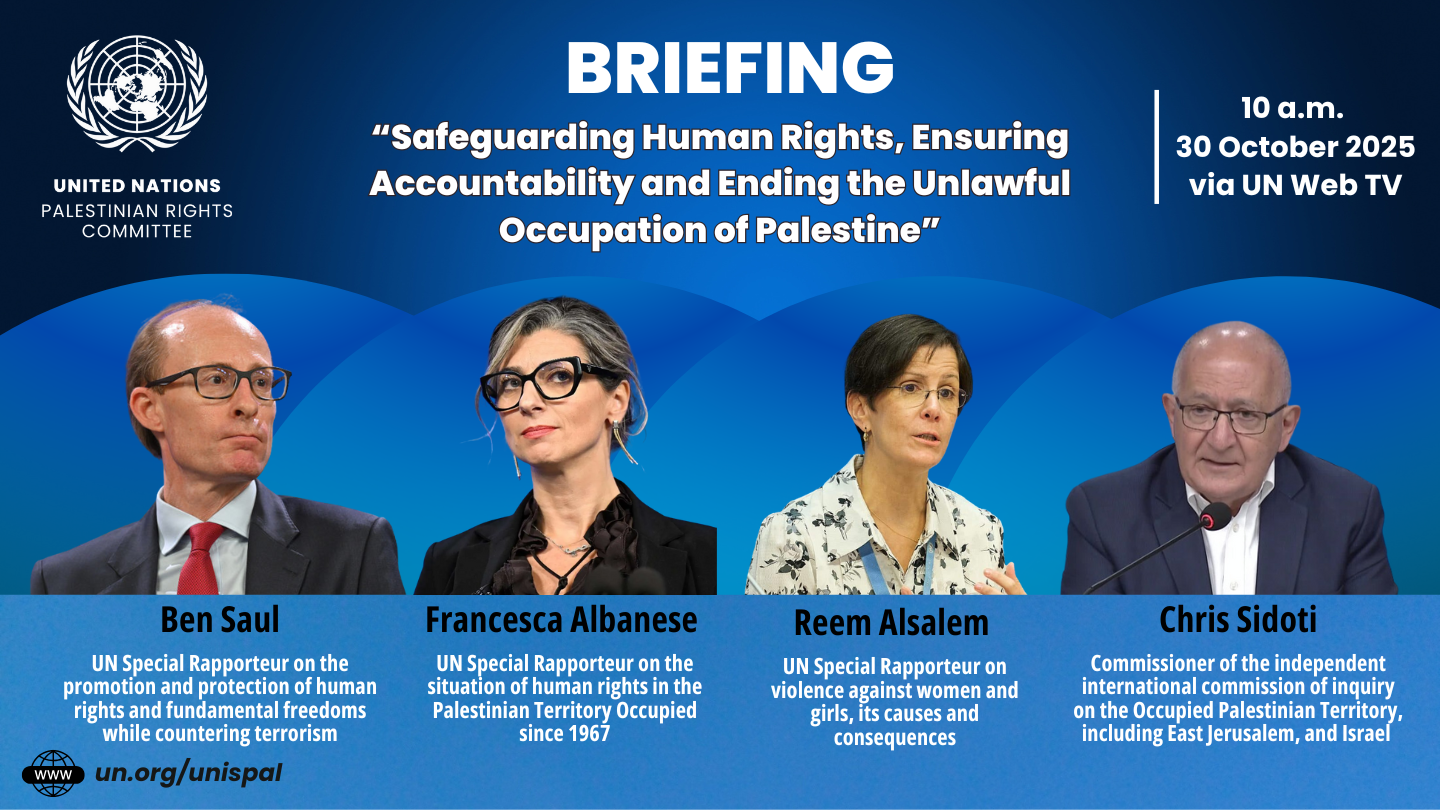
On 30 October 2025, the Committee on the Exercise of the Inalienable Rights of the Palestinian People held a virtual briefing, streamed on UN Web TV, titled “Safeguarding Human Rights, Ensuring Accountability and Ending the Unlawful Occupation of Palestine”. The Committee Chair, Ambassador Coly Seck, opened the meeting by situating the discussion in the context of two years of intense suffering in Gaza and recent developments since the 13 October 2025 Gaza Peace Summit, including a fragile ceasefire, the release of Israeli hostages and Palestinian prisoners, and a phased withdrawal of Israeli forces. He underlined the Committee’s mandate and the centrality of a two-State solution on pre-1967 lines, noting the Committee’s 50th anniversary on 10 November 2025.
Briefings followed from Ambassador Riyad Mansour, Special Rapporteurs Francesca Albanese, Reem Alsalem, and Ben Saul, and an intervention by Chris Sidoti of the Independent International Commission of Inquiry. Speakers stressed that accountability must be universal and evidence based. Ms. Albanese urged member states to act on concrete legal obligations identified by the International Court of Justice and to draw lessons from the Hague Group’s approach, while warning against policies that could entrench displacement under the banner of reconstruction. Ms. Alsalem highlighted the failure to reflect gender dimensions in ceasefire arrangements and criticized the omission of Israel from the Secretary-General’s list on conflict-related sexual violence despite multiple independent findings, calling for consistency with the women, peace and security agenda at its 25-year mark. Prof. Ben Saul outlined practical state actions, including halting arms transfers, applying targeted diplomatic and economic measures, supporting and joining international justice institutions, using universal jurisdiction, and considering a General Assembly mechanism for war damage compensation. Mr. Sidoti’s remarks reinforced the need for credible evidence gathering to underpin future accountability.
In the Q&A, member states asked how best to navigate institutional constraints and counter misinformation while strengthening trust in UN reporting. Responses pointed to coordinated diplomacy through groupings such as the Hague and Madrid groups, individual state action aligned with international law, and clear public communication of verified findings. Ambassador Mansour urged a strategy of cumulative, achievable steps, drawing lessons from anti-apartheid movements, and emphasized listening to Palestinians’ immediate call to stop the killing while pursuing longer term justice. Closing the meeting, Chair Seck thanked participants and viewers, reaffirmed support for the mandate holders and the Commission of Inquiry, and stressed that a just and lasting peace requires ending the occupation that began in 1967 and realizing the Palestinian people’s right to self-determination.