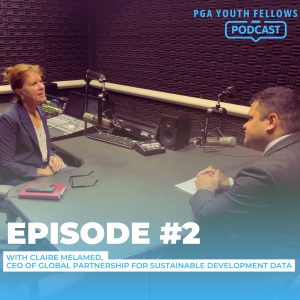
 In the second episode of the OPGA Fellows Podcast, Gerard Anapu speaks with Claire Melamed, who leads the Secretariat of the Global Partnership for Sustainable Development Data. She talks about the importance of data in making progress on the Sustainable Development Goals ahead of the 2030 deadline, and also highlights some of the risks and reasons why Governments shy away from data. Gerard caught up with her in New York, where she was participating in a science briefing to General Assembly Member States.
 LISTEN to Episode #2 on Soundcloud
Episode Transcript:
Claire Melamed: If you care about data, if you care about science, you have to invest in it. And if governments want to get the benefits of data and technology and all of the new opportunities, they have to sit together in buildings like this in the UN and they have to work together. They have to develop partnerships because it’s only through collaboration that we can really get the benefits.
[Opening] Drum roll. My name is Amr Shamun from the Maldives. My name is Aime Triana from Cuba. My name is Syuzanna Martirosyan from Armenia. My name is Mmoloki Tsheole from the Republic of Botswana. My name is Nathalie Gasaro, and I’m from Rwanda. My name is Gerard Anapu from Samoa. This is a podcast. This is the podcast of the United Nations OPGA Fellows.
Dr. Melamed: My name is Claire Melamed and I’m the CEO of the Global Partnership for Sustainable Development Data. The global partnership is a network of about 700 organizations from governments, the private sector and civil society who all share a belief that data is a critical instrument for achieving the Sustainable Development Goals and a commitment to working together to make that happen.
Gerard: Thank you, Dr. Melamed. It’s indeed a pleasure to have you here. And please tell us what brings you to the United Nations today.
Dr. Melamed: Well, I’m absolutely delighted to be here today at the invitation of the President of the General Assembly, to speak on a panel at a scientific briefing for Member States. I think this is such a great initiative because while of course the main business of the UN is politics and political negotiations, and you know, I think we all understand at the moment how much we need these multilateral institutions and places where governments can come together. But of course we have at our disposal into help decision makers, to help actions to make the world a better place, a wealth of science and technology. And it’s critical that those people engaging in the kind of political negotiations around multilateralism understand both the potential of all of that science and technology, and how they can deploy it to make the world a better place. But also, of course, some of the risks.
Gerard: Dr. Melamed, thank you. Can you please tell us why data is important for sustainable development and in the context of leaving no one behind?
Dr. Melamed: Without data, governments are really making decisions in the dark. If they don’t have the data that tells them how to allocate resources, what are the right decisions to make, then it becomes that much harder to make the right choices about the right policies to improve people’s lives. And it’s often, I think we kind of assume that the data is there, but often it really isn’t you know. If we think we’ve all, of course, you know, coming out of the COVID pandemic, where we became incredibly aware of data every day. We were all pouring over the charts and the tables about infection rates and deaths and so on. But it’s important to understand that in a large number of the countries of the world, deaths aren’t registered. We don’t have good data on deaths. So the figures that we see about death rates globally are estimates and guesstimates and, you know, the sort of calculations done in a fairly, you know, rough and ready kind of way. They’re not wrong, but they’re not the actual data they’re estimates. And there are too many really critical areas where that’s still the case. And the Sustainable Development Goals, I think, we’re this year in 2023, we’re at the halfway point of the Sustainable Development Goals. And that is really pointing up to all of us, I think, the gaps that remain in the data, which is so critical to monitor those goals. There’s only three goals, three of the 17 Sustainable Development Goals, for which more than half of countries have more than two data points since 2015. Now that’s a complicated sentence. But what it basically means is that it’s very, very difficult for most countries to actually know with any certainty, what the trends are in those key sustainable development goals. And this is at the halfway point. This is not a necessary state of affairs. It’s easily solvable this challenge. But to solve it, we need money, and we need people to decide that that’s what they want to do. And unless we have that data, it’s going to be that much harder to accelerate progress over the second half of this SDGs period to really make the progress that we need to achieve the goals by 2030.
Gerard: Traditionally, information and data is something that governments, people don’t really share or it’s an issue for us to sort of collect. Can you give us some examples of initiatives you have taken on to revolutionize how we collect, manage, and use data?
Dr. Melamed: There are two problems that we’ve really confronted with trying to drive the sort of collaboration and cooperation, which is so key in making use of the new data technologies. One is because data is so powerful, there’s of course a tendency for institutions to want to keep it to themselves, not to share it, not to trust others, to use it well, not to combine it with other data sources. But data is so much powerful when it is combined. So one of the things that we constantly struggle with is trying to find ways to get institutions to work together to share data, to collaborate, and so on. And this is different parts of government. This is the public sector and the private sector. This is civil society, everyone has a stake in this. The other challenge, of course, is that data while incredibly powerful, can also be harmful. That is very much the business of the UN, where we’re sitting. And the multilateral system, in general, to try to make sure that we together globally set the right rules to use this technology for good.
Gerard: Thank you. Dr. Muhammad, you mentioned that you were here for a science briefing and, of course, throughout our discussions, you mentioned the importance of science and decision making and making informed policies. Can you tell us what your views on science and diplomacy and what do you believe the value of science and Member States decision making and governments?
Dr. Melamed: Sure. Well, I fear that something of a disadvantage here being neither a scientist nor a diplomat. But from an as an outsider perspective, let me say that I think that given the critical importance of science and the technologies that are produced by science for all of us. In terms of how we live our lives, the way that technologies impact on everyday lives in terms of the way that we’re governed and the increasing use by governments of new technologies for good, to help to deliver essential services, for security, for warfare, and so on, and, of course, the increasing commercial relevance of science and technology. And the fact that our economies are driven by competition over science, to control science, and to develop new technologies. It’s absolutely critical that we all understand this new world that we’re living in, and that those who govern us – the politicians, and the diplomats – are doing their very best to make sure that all of this opportunity of science is being harnessed to solve the problems that we face rather than to, as in some cases, create new ones. So I for one, as neither a scientist nor a diplomat are very, very grateful and pleased that the UN is looking seriously at these issues and is taking seriously the need for multilateralism. To address some of the new challenges posed by the global dilemmas and debates over science and technology, as well as thinking about how to mobilize the new possibilities to achieve the UN’s critical agenda 2030. One of the most exciting parts of my job is working with governments who understand the opportunities of these new technologies and are excited and enthused about using them to try to solve some of the many challenges that we all know that they confront at the global partnership, we work with about 40 governments around the world. All of whom understand that the potential here and a keen to collaborate to develop the kind of partnerships that can help to make sure that they’re using data for the benefit of their populations. And to do tha, we broker partnerships between governments, the private sector. We focus a lot on capacity development. That’s one of the things that really holds governments back from using these new technologies is often a lack of skilled people, a lack of the right skills to help to use these technologies inside governments. But when they get it right, when the partnerships are developed when the capacities are there, when the political leadership is there – and that’s a critical critical part of the equation – sometimes you start to see what’s possible and this happens in all kinds of ways. So one of the countries we’ve been working in for a long time is Senegal, where they’re, clearly all countries are facing very uncertain and difficult challenges because of climate change and Senegal, they’ve been using satellite imagery to help to understand the implications of the changing climate, particularly for agriculture. It’s helped them to understand where they most need to distribute the climate resistant crops and really make sure that they’re using the best their scarce resources and the best possible way to help farmers to tackle, to tackle climate change. And then we also working with civil society groups who are using data as an instrument of change and really using, collecting data on some of the world’s most vulnerable populations to help to make sure that their needs are taken into account in policy-making and in the allocation of resources. And there are so many inspiring examples, homelessness advocates here in New York City, gender advocates around the world, people focused on the challenges of people with disabilities, really using data as an instrument of power to make their populations visible and to insist that politicians take notice.
Gerard: Thank you. Well, as we come towards the end of our discussion today, maybe you can tell us what two main messages you want people to take away from our discussion.
Dr. Melamed: I’m here to I’m here today to talk primarily about data and about the essential importance of data as an input for decision making and as an instrument for making the world better. But of course, we only have the data that we invest in. So my first message today is to say to politicians, primarily, that they need to invest in data. Some research that we did at the global partnership showed that for every $1 invested in data systems, governments can expect an economic return of around $32. So investing in data is not only incredibly important for making the right decisions, it’s also an incredibly good investment. So that is my first message today. If you care about data, if you care about science, you have to invest in it. And I think my second message today is that data is very much a team sport. And if governments want to, want to get the benefits of data and technology and all of the new opportunities, they have to sit together and buildings like this in the UN and they have to work together. They have to develop partnerships because it’s only through collaboration that we can really get the benefits of these new technologies and of the data which flows from them.
Gerard: All right. Thank you very much. That was indeed a very fruitful discussion with you today on the use of data and technology and science. And it was a pleasure having you with us and look forward to seeing and follow your work in the future.
Dr. Melamed: Great pleasure.
Gerard: Thank you so much for being here.
Dr. Melamed: Thank you so much for the conversation.
[Closing] This is the podcast of the United Nations OPGA Fellows. Thanks for listening.