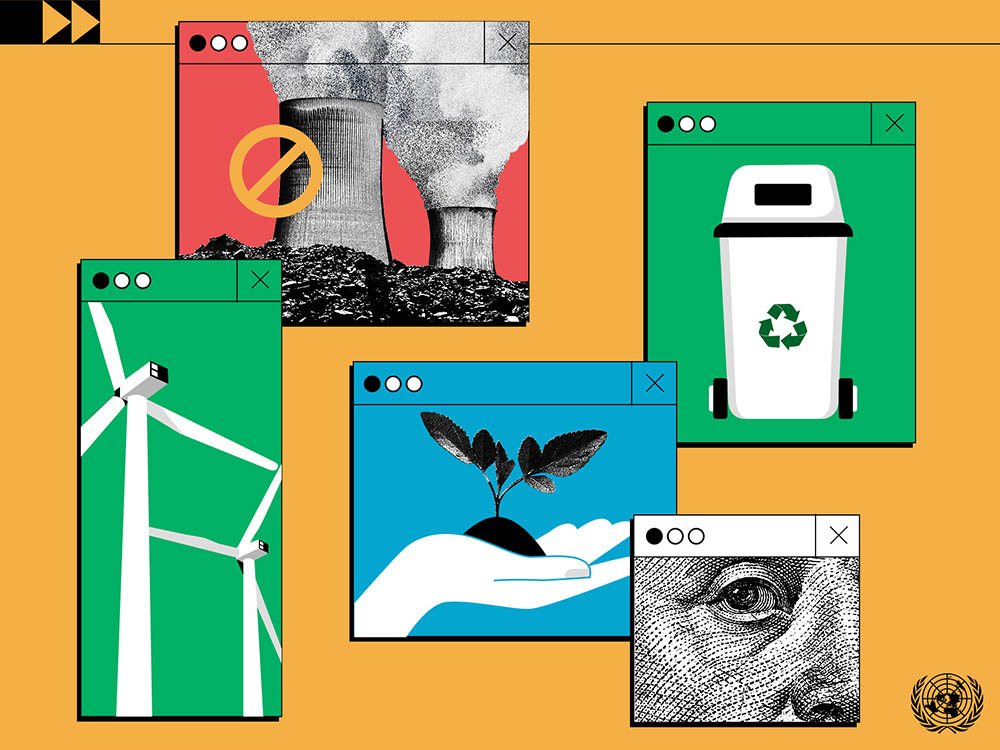
Science, Solutions, Solidarity
For a livable planet

Climate Summit 2026
On 23 September 2026, UN Secretary-General António Guterres convened leaders from government, business, finance, civil society and other sectors to accelerate climate action and advance a just energy transition. Leaders called for faster deployment of proven solutions, a shift to clean energy, increased climate finance, stronger resilience and renewed international cooperation to protect people and livelihoods.

Taking action on methane
The Secretary-General’s Call to Action highlights how methane reductions can deliver immediate climate benefits alongside cleaner air, stronger food systems and economic opportunity.

Explainers: Transforming climate issues into action
Learn more about how climate change impacts are felt across different sectors and ecosystems, and why we must nurture rather than exploit nature’s resources to advance climate action.
For information integrity
Brazil, UNESCO and the UN have joined forces to strengthen research to counter narratives that are delaying and derailing urgently needed climate action.

Adapting to the impacts of climate change
Beyond doing everything we can to cut greenhouse gas emissions and slow the pace of global warming, we must adapt to the unavoidable impacts of climate change.
We must match an accelerating crisis with accelerating action. Match the revolution in energy with a revolution in finance. And match rising impacts with rising protection.
ANTÓNIO GUTERRES, United Nations Secretary-General (23 September 2026)

Watch, Listen and Share
Amidst humanitarian and climate crises, a land movement emerges in the Sahel
Since 2018, the Sahel Integrated Resilience Initiative has strengthened food security and livelihoods for more than four million people by rehabilitating over 335,000 hectares of land. It has done so through a unique combination of basic-needs safety nets and long-term ecosystem restoration.
Climate Justice: Who Pays The Price?
This UN explainer examines climate overshoot and the question of climate justice. It looks at how rising temperatures can accelerate impacts such as melting glaciers and extreme weather, while the countries and communities facing the greatest consequences may not be those most responsible for historic greenhouse gas emissions
Climate Promise: Forward, Together
Across more than 100 countries, the UN's Climate Promise is helping turn climate pledges into real, measurable action: scaling renewable energy, strengthening resilience to unlocking finance, building sustainable economies and more.



Climate issues
What do food, health, water or energy have to do with climate change?

National climate plans
What are Nationally Determined Contributions, and why do they matter?
Powering a safer future
Why shift to renewables like wind and solar? Find out here.