

Messages 2026
Secretary-General Message
This year’s World Water Day reminds us that safe water and sanitation play a critical role in supporting the rights and health of women and girls.
When access is lacking, it’s women and girls who pay the highest toll, relying on unsafe toilets; caring for family members made sick from contaminated water; and spending hours each day retrieving water from crowded communal sources – a chore that keeps many girls home from school.
But this year’s theme points to the solution: “Where water flows, equality grows.”
It’s time for governments to scale up investment and strengthen national water and sanitation systems, through improved delivery capacities, workforce training and reliable financing. Developed countries must share the technologies, expertise and financing required to build safe, sustainable and resilient water and sanitation infrastructure. And women must be at the decision-making table to ensure these systems meet their needs.
Too often, water is a source of conflict. But it can also unite people and be a contributor to peace. This year’s UN Water Conference will bring the world together to accelerate progress on water and sanitation for all.
Together, let’s make water a force for gender equality, and let the benefits flow to every community in the world.
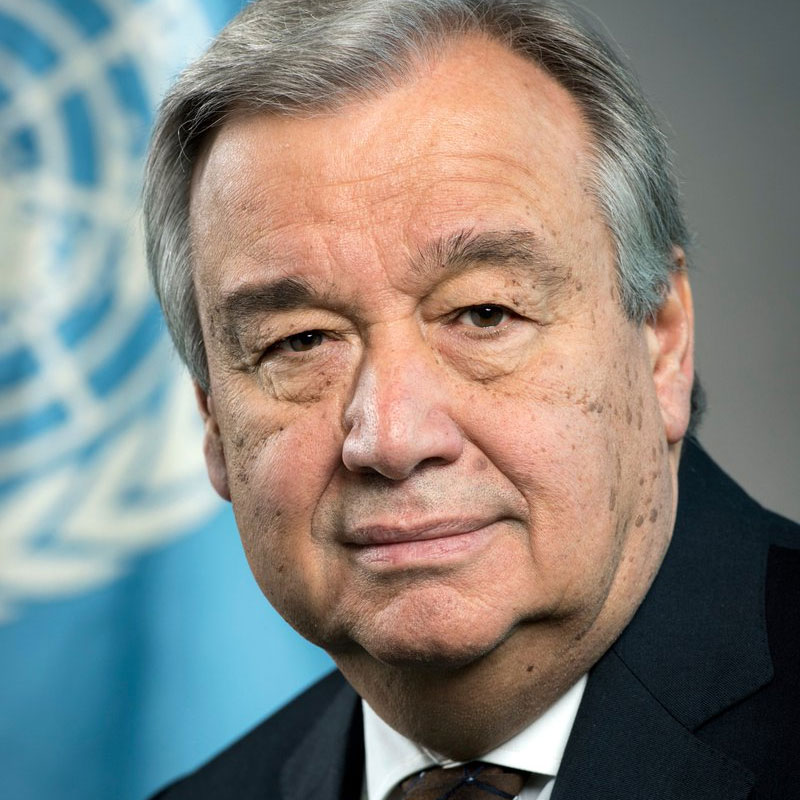
UN Secretary-General, António Guterres
Together, let’s make water a force for gender equality, and let the benefits flow to every community in the world."
António Guterres
UN-Water Chair Message
Women can be many things at once: mothers, workers, caregivers, leaders. When water is unsafe, or far from home, they are the ones expected to carry the burden on top of everything else.
Safe water and sanitation services, close to home, protect women and girls’ time, health, safety and opportunity – providing the foundation of a healthier, more fulfilled life.
Yet for millions, drinking water at home is still not a reality. In two out of three households, water collection is primarily women’s responsibility.
That can mean queuing or walking long distances to fetch water, often from unimproved or unsafe sources like rivers and ponds.
These daily journeys carry risks and indignities that are too often invisible.
This makes the water crisis a women’s crisis. And women remain underrepresented in the decision-making that shape water systems and services.
That must change.
It is time to centre women and girls in water solutions – as users, leaders and workers – so they can play an equitable role alongside men to ensure water-related services meet everyone’s needs.
We need women and men, girls and boys, to manage water together as a common good that benefits the whole of society.
Because where water flows, equality grows.
UN-Water Chair, Álvaro Lario
It is time to centre women and girls in water solutions – as users, leaders and workers – so they can play an equitable role alongside men to ensure water-related services meet everyone’s needs."
Álvaro Lario

UN-Habitat Executive Director Message
Water and sanitation are not only a matter of infrastructure. They are also a matter of equality, dignity and rights.
This year, World Water Day focuses on water and gender. The UN World Water Development Report 2026 highlights how unequal access to housing, land, and basic services can leave people without clean water and sanitation.
For women and girls, especially in slums and informal settlements, inequality in land and housing often limits access to essential services.
That is why UN-Habitat works to advance more inclusive land governance, strengthen basic services, and transform informal settlements and slums.
By 2025, UN-Habitat had helped over 2.7 million people gain access to water and sanitation and strengthened hundreds of utility partnerships around the world.
Water and sanitation cannot be separated from housing, land rights, and basic services. Everyone has a right to safe water and sanitation, and UN-Habitat will continue working with cities, communities, and partners to make that a reality.
I invite you to join us to continue engaging on these critical issues to accelerate progress at the thirteenth session of the World Urban Forum, taking place from 17 to 22 May in Baku, Azerbaijan, on the theme “Housing the world: Safe and resilient cities and communities”.
Executive Director of UN-Habitat, Anacláudia Rossbach
Water and sanitation cannot be separated from housing, land rights, and basic services. Everyone has a right to safe water and sanitation, and UN-Habitat will continue working with cities, communities, and partners to make that a reality."
Anacláudia Rossbach

UN High Commissioner for Human Rights Message
The global promise of safe drinking water and sanitation for all is slipping through our fingers.
Today, 2.1 billion people still lack access to safe drinking water, putting entire communities at risk of preventable diseases.
Behind these numbers are hundreds of millions of women and girls walking hours each day to fetch water, sacrificing education, opportunities, and livelihoods.
Mothers are giving birth without clean water – risking deadly infections for themselves and their newborns.
The water crisis is a gender equality crisis.
Where water is scarce, inequality deepens, and those already in vulnerable situations are pushed even further behind.
Gender inequality permeates everything: who turns on a tap and who walks miles for water; whose water is safe and whose is contaminated; whose voices shape decisions on the management of rivers, aquifers and water infrastructure – and whose voices are silenced and ignored.
Access to safe water is about more than survival.
Water is life. Water is dignity. Water is a human right.
Yet climate change, pollution, conflict, and unsustainable resource extraction - including industrial agriculture and data centers that use huge quantities of water - are placing unprecedented pressure on strained water systems.
Without bold action, water scarcity will continue to fuel instability and widen inequalities.
With the UN Water Conference approaching in December, 2026 must be the year in which commitments finally become action.
States and local governments must prioritize gender-responsive water policies, budgets, plans, and programs.
The private sector must conduct due diligence on water management, based on human rights.
And the international community must strengthen cooperation over competition in managing this vital resource.
Investment in water is an investment in dignity, equality, public health, and sustainable development.
It is an investment in people – and especially an investment in women and girls.
Thank you.
UN High Commissioner for Human Rights, Volker Türk
Investment in water is an investment in dignity, equality, public health, and sustainable development."
Volker Türk

UNSG's Special Envoy on Water Message
Water shapes daily life everywhere – but not equally.
For millions of women and girls, a day still begins with the search for water. It can mean long walks, missed school, lost income and exposure to danger. Around the world, women and girls spend hundreds of millions of hours each day collecting water, time that could otherwise be used for education, work and participation in community life.
Safe drinking water, sanitation and hygiene are human rights and the foundation of dignity, health and opportunity. Yet more than one billion women still lack access to safely managed drinking water services, and in most households without water on the premises, the responsibility for collection falls primarily to them.
This is why the water crisis is also a challenge to gender equality and women empowerment.
But women are not only those most affected – they are also leaders, innovators and agents of solutions. From women-led enterprises providing safe water to rural communities to women strengthening resilience to drought and disasters, their leadership makes water services more sustainable and inclusive.
As we prepare for the 2026 United Nations Water Conference, we must accelerate action that places women and girls at the centre – not only as beneficiaries, but as partners, professionals and decision-makers. Investing in women and water will strengthen communities, economies and peace.
I am a woman. I know that when women participate in decisions and actions about water, systems work better for everyone.
Let this World Water Day be a call to act, together, so that safe water empowers every woman and every girl, everywhere.
UNSG's Special Envoy on Water, Retno Marsudi
We must accelerate action that places women and girls at the centre – not only as beneficiaries, but as partners, professionals and decision-makers."
Retno Marsudi

UN Women Executive Director’s Message
In a world shaped by climate change, growing inequalities, and increasing pressure on natural resources, water lies at the heart of our shared future.
Water is essential for life, health, food, and livelihoods. Yet for billions of people, access to safe water and sanitation remains out of reach. And while the global water crisis affects everyone, it does not affect everyone equally.
Women and girls bear the greatest impacts of the unequal access to and scarcity of water. Every day, they spend millions of hours collecting water, caring for families, and managing scarcity, often at the cost of their education, income, health, and safety. When water is unsafe or unavailable, inequalities deepen and opportunities disappear.
This reality was already recognized thirty years ago in the Beijing Declaration and Platform for Action, which underscored the central role of women in environmental sustainability and called for their full participation in the management and safeguarding of natural resources, including water. Today, those commitments are more urgent than ever.
But women are not only the most affected by the water crisis; they are also powerful agents of change.
This World Water Day, under the theme “Water and Gender Equality – Where water flows, equality grows,” we call for a transformative, rights-based approach that places women’s leadership at the centre of water solutions. We must invest in gender-responsive water governance, financing, and services; and ensure that no woman or girl is left behind.
Water can be a force for equality, resilience, and prosperity. Together, let us make it so: for all women and girls, for communities, and for generations to come.
UN Women Executive Director’s Message, Sima Sami Bahous
We must invest in gender-responsive water governance, financing, and services; and ensure that no woman or girl is left behind."
Sima Sami Bahous

UNEP Executive Director’s message
World Water Day reminds us that healthy freshwater ecosystems are essential for resilient societies, yet their degradation disproportionately affects women and girls. In many communities, women are the first to feel the impacts of declining water quality, pollution, or scarcity. At the same time, women are among the most knowledgeable and committed custodians of water resources.
The 2026 theme, Water and Gender, underscores the urgency of embedding inclusivity and gender equality into the governance of freshwater ecosystems. This becomes all the more important as the impacts from climate change, desertification, land degradation, biodiversity loss and pollution are severely impacting freshwater access and therefore water security. Around the world, women are hydrologists, freshwater experts, policymakers, citizen scientists, and community leaders. Women’s leadership and lived experience offer essential solutions to protecting rivers, lakes, wetlands, aquifers and the communities and livelihoods that depend on them.
UNEP works with governments and institutions to strengthen the evidence base needed to design equitable water policies, improve gender responsive data, and monitor progress toward a more inclusive global water agenda.
Recognizing women’s leadership in decision-making and community water management, valuing their local environmental knowledge, expanding opportunities for meaningful participation, and embedding equality in water governance are critical to protecting freshwater ecosystems and ensuring no one is left behind.
UNEP Executive Director’s message, Inger Andersen
In many communities, women are the first to feel the impacts of declining water quality, pollution, or scarcity. At the same time, women are among the most knowledgeable and committed custodians of water resources."
Inger Andersen
