Sustaining Support for Afghanistan Amid Deepening and Intersecting Crises

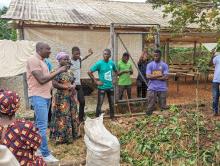
Afghanistan is contending with one of the largest waves of returns in recent history. The United Nations provides border reception services and supports sustainable reintegration projects in communities of origin. © UN Afghanistan
Improving irrigation systems is vital for farming and alternative livelihood crops. Rehabilitation of the Khaksari canal intake enabled effective irrigation in Badakhshan province. © UNODC/Hussain Ali Hazara
Community voices are central to United Nations work. A United Nations delegation met residents in Helmand province to review projects and hear feedback on sustainable initiatives. February 2025. © UN/Abdul Rahman Zaeem

In Afghanistan, the United Nations has adopted an approach that balances urgent humanitarian interventions with the sustained delivery of basic human needs assistance. 

Turning Food Waste Prevention into a Scalable Climate Solution

An urban farm in Brazil. Photo credit: Fellipe Abreu, FGVCes
Food loss and waste drives a major climate problem, generating an estimated 8–10 per cent of global greenhouse gas emissions. Adobe Stock
Land being converted for use as an urban community garden in Brazil. Photo credit: Fellipe Abreu, FGVCes

The 2026 International Day of Zero Waste focuses on food waste, underscoring the scale of the challenge and the global momentum now coalescing behind solutions.

Future Forward: Universalizing Climate Action to Bend the Curve of Climate Change for Global Sustainability

Students participating in a "sustainability accelerator" exercise though the 1 Million for 1 Billion (1M1B) Foundation. Photo credit: 1M1B
Launch of the 1.5 Matters initiative. Maher Nasser, Director of the Outreach Division of the United Nations Department of Global Communications, stands third from right. Photo credit: 1M1B
Graphic showing the key thematic areas of green internships with measurable outcomes. Credit: 1M1B
Launch of 1M1B Green Skills Academy Job Readiness Centre. Photo credit: 1M1B

When sustainability is incorporated into the learning journey, it cultivates leadership, empathy and innovation – essential traits for climate-resilient citizenship.

In a Warming World, Agriculture Must Be at the Heart of Climate and Clean Air Action

 A rice paddy field in Angkor, Cambodia, 17 August 2013. Diego Delso/delso.photo/CC BY-SA

Sustainable practices, more efficient systems and cleaner alternatives in agriculture can reduce greenhouse gas emissions and air pollution, while also improving yields, lives and livelihoods.

The Urgent Need to Preserve Glaciers in a Warming World

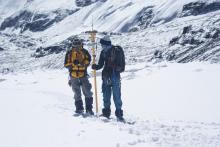
Worker installing stakes on one of the key benchmark glaciers of Rikha Samba Glacier Mustang, Nepal. The International Centre for Integrated Mountain Development (ICIMOD) has been doing this annually for 13 years. Photo: Tenzig Chogyal Sherpa
Team conducting DGPS survey at Rikha Samba Glacier in Nepal. Photo: Tenzing Chogyal Sherpa

Climate change and other drivers have accelerated glacier melt, threatening water security, biodiversity and regional economies.

Who Is Protecting Antarctica’s Environment?

Neumayer Channel in the Antarctic Peninsula, January 2020. Antarctica's ice and its biological communities face grave, systemic threats from global climate change. Photo: Alessandro Antonello
United Nations Secretary-General António Guterres (third from right, seated) on his way to the Base General Bernardo O'Higgins in Antarctica, where he witnessed first-hand the deadly impacts of the climate crisis, 23 November 2023. UN Photo/Mark Garten
In 2023, Secretary-General António Guterres visited Antarctica to witness the impacts of the climate crisis, 22 November 2023. UN Photo/Mark Garten

The Antarctic Treaty System, in place since 1961, is principally dedicated to the environmental threats that arise locally, including those from fishing, tourism and scientific research.

Sunsets, Anger and Activism: On Youth Leadership in Urbania

River Elbe in Hamburg. By Ed Alvarado/Pexels
©Lena Faye
Sankt-Pauli-Landungsbrücken, Hamburg, Germany. Wikimedia Commons

There is good news: the youth climate justice movement has officially declared that we do not intend to wait until someone invites us to make decisions affecting our own present and future.

Population and Climate Change: Decent Living for All without Compromising Climate Mitigation

Houses and parked cars in Jerteh, Terengganu, Malaysia, 2020. Pok Rie
Raya Muttarak (right) collecting data for a survey focusing on climate change adaptation in Thailand. Phang Nga, Thailand, 12 March 2013.

A rise in the demand for energy linked to increasing incomes should not be justification for keeping people in poverty solely to avoid an escalation in emissions and its effects on climate change. 

Rising Hopes Amid Rising Seas: Developments in International Law Addressing the Threat of Sea-Level Rise

A small uninhabited Island in Baa Atoll, Maldives, 2018. Hoodh Ahmed/Unsplash
Aerial view of Malé, capital of Maldives, 2019. Photo: Asian Development Bank
A view from the Bransfield Strait during the visit to Antarctica of United Nations Secretary-General António Guterres, who saw first-hand the sea ice melting into the ocean at record rates, 22 November 2023. UN Photo/Mark Garten

The impacts of sea-level rise linked to climate change raise important questions of international law.

Inequality, Tsunamis and the Climate Crisis: Achieving a Resilient Future for All
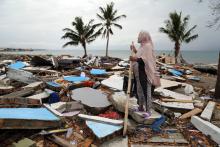
A woman stands on collapsed structures in Mamboro fishing village, Central Sulawesi, Indonesia, following the 2018 earthquake and tsunami there. Photo: OCHA/Anthony Burke
A ruined building, knocked on its side, in Onagawa port, adjacent to Ishinomaki, Japan, considered the centre of the tsunami that struck the country in 2011. Photo: OCHA/Masaki Watabe

Disaster risk reduction, which lies at the nexus of development, humanitarian response and climate change, will strengthen resilience in each area, saving lives and ultimately advancing sustainable development.