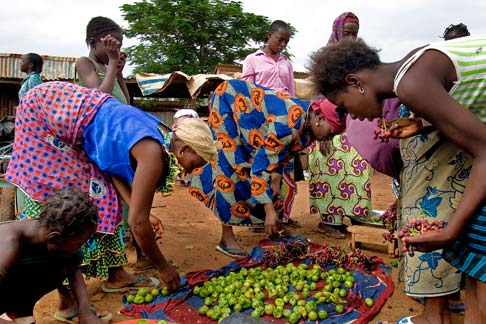
Photo: Women buying fruit in a downtown market in Ouagadougou, Burkina Faso. FAO is implementing its Initiative on Soaring Food Prices (ISFP) in the country to rapidly boost food production in order to increase food availability and accessibility and to alleviate the effects of soaring food prices on poor and vulnerable groups. Read more
Supporting Rural Women to Cope with High Food Prices
During the 2006-2008 food crisis, international prices for staple foods rose dramatically, pushing more people worldwide into hunger and undernourishment than ever before. Prices declined in the second half of 2008 but spiked again in 2010 and will likely remain high and volatile over the next decade.
As in previous global crises, poor rural households in developing countries were the hardest hit. Poor rural women were particularly affected because they lag behind in access to resources like credit, land, technologies and infrastructure, which reduces their purchasing power. The crisis has drawn attention to the vulnerability of poor countries and populations to global shocks and to the need for countries to put in place better mechanisms to protect the most vulnerable populations.
The impact of high food prices on poor rural households
Rural households have little to no resources—such as savings or access to credit—to help them face high food prices, and the poorer the household, the more its members have to change their way of living to cope: they reduce spending on non-food items like healthcare and education; eat smaller or fewer meals and less expensive, less nutritious food; borrow money to buy food; and work longer hours or take on additional work to earn more money.
How do rural women cope with high food prices?
Rural women adopt specific behaviors and measures to soften the effects of high food prices on their families:
As traditional food providers and carers for their households, they tend to act as ‘shock absorbers’, giving their food to their children and their husbands to prevent them from going hungry, and spending more time caring for sick relatives as households cut back on health expenses.
Women also look for more part-time employment or work longer hours on top of their existing jobs and household responsibilities to earn more money for their families. They may also look for additional credit to afford food and other basic necessities, and are susceptible to get into debt because their lack of access to formal credit may force them to turn to moneylenders, pawn brokers and other sources of expensive credit.
“Prices of food have really gone up and this has made my children and I not to eat as we used to. We used to eat four times a day but now we can only eat two times under hard struggle.” -- Salome Nche, mother of eight, Cameroon excerpt from the Huairou Commission report “Grassroots Women’s Perspectives on Food Insecurity in Africa, Asia and Latin America,” 2009
To cope with higher food prices, poor households at times have to sell assets, like livestock, seeds, or tools, which are very difficult to regain. Women’s traditional assets, like jewellery and small livestock, tend to be sold first because they are easier to recover later than men’s assets such as land and large livestock.
Children are also affected—they may be taken out of school to either be sent to work to supplement the family’s income or to help with household chores while their mothers take on additional work. The former is more likely for boys and the latter for girls.
What can governments do to support rural women and rural households to deal with high food prices?
Countries can support rural households, and especially rural women, to cope with high food prices by putting in place or expanding food assistance and social safety net programmes that take into consideration men and women’s different roles and responsibilities within households and the different behaviors they adopt in times of crisis.
Through food assistance schemes, governments provide households with food rations to compensate for lacking food supplies. This includes giving households food stamps or vouchers that people can exchange for food, implementing school feeding programmes where meals are given to children in school, and food-for-work programmes where people are given food rations in exchange for their work on public projects like building roads.
Social safety net programmes work similarly, except that they provide households with cash to buy food and other necessities instead of food rations. These programmes include cash transfers where governments give periodical payments to households, and public work programmes, which are similar to food-for-work programmes, except that they compensate people in cash.
Food assistance programmes are advantageous for rural women who are traditionally responsible for obtaining food and ensuring good nutrition for the family. These programmes may reduce women’s need to take on additional work to obtain more income to buy food and, in some cases, increase their decision-making power in the household. For example, in Ethiopia, women working in public work schemes indicated that they preferred being paid in food rations rather than cash as this prevents their husbands from spending earned resources on non-food items.1
School feeding schemes are also a helpful measure because they motivate parents to keep children in school in times of crises, ensuring that they receive the nutrients they need and maintaining their chances at better opportunities later in life. These schemes are particularly important for girls, who tend to be pulled out of school before boys.
Cash transfers are also instrumental in supporting women, especially when the transfer is directed directly to them, and public work programmes that are designed to include them have many beneficial effects, including improving their access to credit since their participation in the programme is often viewed as a guarantee of repayment.
By building programmes that take into consideration rural women and men’s differentiated needs and resources, governments can better strengthen rural communities’ resilience and ability to cope with high food prices and food price sparks in the long run.
*) FAO launched the Initiative on Soaring Food Prices (ISFP) in December 2007. Under this initiative, FAO is working to help smallholder farmers grow more food and earn more money. FAO works with governments to make sure farmers have sustained access to quality seeds, fertilizers and tools as well as technical assistance, training and credit, and is supporting work to improve rural infrastructure such as roads, irrigation systems, storage and market facilities, and to promote better management of water and land resources. Click here for more information about the Initiative on Soaring Food Prices (ISFP), or visit http://www.fao.org/isfp/isfp-home
UN resolutions and reports
Resolutions
Resolution adopted by the General Assembly: 64/140. Improvement of the situation of women in rural areas (A/RES/64/140)
[ Arabic | Chinese | English | French | Russian | Spanish ]
Resolution adopted by the General Assembly: 62/136. Improvement of the situation of women in rural areas (A/RES/62/136)
[ Arabic | Chinese | English | French | Russian | Spanish ]
Reports
Improvement of the situation of women in rural areas - 2011 Report of the Secretary-General (A/66/181)
[ Arabic | Chinese | English | French | Spanish | Russian ]
Improvement of the situation of women in rural areas: 2009 Report of the Secretary-General (A/64/190)
[ Arabic | Chinese | English | French | Spanish | Russian ]
Improvement of the situation of women in rural areas: 2007 Report of the Secretary-General (A/62/202)
[ Arabic | Chinese | English | French | Spanish | Russian ]
World Survey on the Role of Women in Development: Women’s control over economic resources and access to financial
resources, including microfinanc - Report of the Secretary-General (A/64/93)
[ Arabic | Chinese | English | French | Spanish | Russian ]
Resources on other UN websites
The State
of Food
and
Agriculture
2010-2011:
Women in agriculture: closing the gender gap for development
The State of Food and Agriculture 2010–11
makes the “business case” for addressing gender
issues in agriculture and rural employment. The
agriculture sector is underperforming in many
developing countries, in part because women
do not have equal access to the resources and
opportunities they need to be more productive.
The gender gap imposes real costs on society in
terms of lost agricultural output, food security
and economic growth. Promoting gender
equality is not only good for women; it is also
good for agricultural development. FAO
Rural Poverty Report 2011 - New realities, new challenges:
new opportunities for tomorrow's generation
The Rural Poverty Report 2011 provides a coherent and comprehensive look at rural poverty, its global consequences and the prospects for eradicating it. The report contains updated estimates by IFAD regarding how many rural poor people there are in the developing world, poverty rates in rural areas, and the percentage of poor people residing in rural areas. IFAD, 2010
In Focus: Rural Women
Celebrated annually on 15 October, the International Day of Rural Women pays tribute to rural women and the critical role they play in global economies. From Asia to the Americas, learn more about what UN Women is doing to empower rural women and how you can get involved. http://www.unwomen.org/infocus/rural-women/
Rural Poverty Portal
Powered by the International Fund for Agricultural Development (IFAD), the Rural Poverty Portal is a website where rural poor people, policy-makers, donors, research institutes, non-governmental organizations and other development partners can share information about eradicating rural poverty. The portal includes a section on "Gender and rural poverty" at http://www.ruralpovertyportal.org/web/guest/topic/home/tags/gender
55th session of CSW: Panel for 2012 - The empowerment of rural women (UN Webcast, 24 Februar 2011)
IFAD: International Day of Rural Women 2011
TThe United Nations’ International Day of Rural Women celebrates and honours women and girls living in rural areas on 15 October each year. It recognizes the huge role that rural mothers, daughters and grandmothers play in producing food, and building agricultural and rural development worldwide.
Communicating gender for rural development
This document is designed to promote the introduction of a gender perspective into communication for development initiatives in rural areas. The publication will be useful to all development practitioners, particularly rural communicators and staff of community radio stations.
FAO at work 2010-2011: Women key to food security
This year’s FAO at work looks at the huge boost to food production that would occur if women farmers were given the same access as men to productive resources such as land and credit. The publication also reviews the evolution of the US$1.5 billion FAO field programme and highlights key events and achievements during the time period.
Video: How do you use ComDev to promote women's participation?
Communication for Development (ComDev) is a mediation process that uses communication technologies and media tools to promote social development. Eliane Najros, FAO Dimitra Project Coordinator, explains how ComDev is used to promote the active involvement of both rural women and men in decision-making.
Video: Why do you use ComDev with a gender sensitive approach?
Communication for Development (ComDev) is a mediation process that uses communication technologies and media tools to promote social development. Eliane Najros, FAO Dimitra Project Coordinator, explains why ComDev is used with a gender-sensitive approach in the Dimitra project.
The Vital Role of Women in Agriculture and Rural Development
This document, prepared for the Thirty-seventh Session of the FAO Conference (Rome, 25 June - 2 July 2011), provides evidence on the vital role of women in agriculture and rural
development. It demonstrates that eliminating the gap between men and women in access to
agricultural resources and inputs would raise yields on women’s farms by 20-30 percent and
increase agricultural production in developing countries by 2.5-4 percent, which could in turn
reduce the number of undernourished people in the world by 12-17 percent or 100-150 million
people. The document also reviews policy recommendations and proven strategies for closing
the gender gap in agriculture and rural development.
Gender dimensions of agricultural and rural employment: Differentiated pathways out of poverty
This report is the result of a collaborative effort of the FAO, IFAD and the ILO team working on the Gender Dimension of Rural Employment. It discusses key issues related to gender equality and rural employment in the context of poverty reduction. It presents various policy responses, empirical data and good practices.
Food security in times of crisis: rural women speak out
Hundreds of rural women in Africa, Asia and Latin America took part recently in grassroots consultations on food insecurity and its impacts. A selection of viewpoints...
Agri-Gender Statistics Toolkit
The "Agri-Gender Statistics Toolkit" is a database with a cross range of tools for the collection and use of sex-disaggregated agricultural data, and designed for development specialists and planners. The so-called "AGRI-GENDER DATABASE" provides examples of questions asked in agricultural census programmes implemented in selected countries in Africa over the past two decades, covering the following data items: agricultural population and households; access to productive resources; production and productivity; destination of agricultural produce; labour and time-use; income and expenditures; membership of agricultural/farmer organisations; food security; poverty indicators. Furthermore, the toolkit contains examples oftable formats that facilitate the presentation of gender relevant data in agriculture.
Rural women: powerful agents of change (IFAD 2010)
“Rural women have the potential to propel their households and communities forward, to lift them out of poverty,” says Annina Lubbock, IFAD’s Senior Technical Adviser on Gender and Poverty Targeting. “When investments reach women, transformations begin to occur.”
Women2000 and Beyond: Rural women in a changing world: Opportunities and challenges
Launched on the first observance of the International Day of Rural Women on 15 October 2008, this issue of Women 2000 and Beyond explores the situation of rural women and the full diversity of their experiences in the context of the changing rural economy, including their position within households, community and economic structures; the gender division of labour; their access to and control over resources; and their participation in decision-making. http://www.un.org/womenwatch/daw/public/W2000andBeyond.html
Dimitra
The Dimitra project, launched in 1994 in Brussels, Belgium, by the European Commission, with the support of the King Baudouin Foundation aims to improve the living conditions of rural women. It promotes information exchange and disseminates information on gender equality and rural development, with a focus on Africa and the Middle East. http://www.fao.org/dimitra
FAO – SEAGA
The Socio-economic and Gender Analysis (SEAGA) Programme was established in 1993 to promote gender awareness when meeting development challenges. It aims to incorporate socio-economic and gender equality considerations into development policies, programmes and projects in order to ensure that all development efforts address the needs and priorities of both men and women. http://www.fao.org/sd/seaga/4_en.htm
IFAD
IFAD’s website provides information on the fund’s efforts to mainstream a gender perspective in its work, including in the areas of financial services, markets, technologies, land and other natural resources. http://www.ifad.org/gender/
Gender in Agriculture Sourcebook
A joint product of the World Bank, FAO, and IFAD, the Sourcebook provides an up-to-date understanding of gender issues
with a rich compilation of compelling evidence of good practices and
lessons learned to guide practitioners in integrating gender dimensions
into agricultural projects and programs. http://worldbank.org/genderinag
The International Day of Rural Women directs attention to both the contribution that women make in rural areas, and the many challenges that they face. This international day, established by the General Assembly in its resolution 62/136 of 18 December 2007, recognizes “the critical role and contribution of rural women, including indigenous women, in enhancing agricultural and rural development, improving food security and eradicating rural poverty.” In 2007, at the tenth session of the Regional Conference on Women in Latin America and the Caribbean, Member States of the Economic Commission for Latin America and the Caribbean, expressed in the Quito Consensus their decision to promote the adoption of an International Day of Rural Women “as an explicit recognition of [rural women’s] economic contribution and the development of their communities, in particular with regard to the unpaid work they perform.”
The idea of honouring rural women with a special day was put forward by international NGOs at the Fourth World Conference on Women in Beijing in 1995. It was suggested that 15 October be celebrated as “World Rural Women’s Day,” on the eve of World Food Day, in order to highlight the role played by rural women in food production and food security.
“World Rural Women’s Day” has been celebrated, primarily by civil society, across the world for over a decade. The first International Day of Rural Women was observed in New York on 15 October 2008.