
Sponsors
This exhibit was made possible in part by the generous contributions from the Permanent Missions to the United Nations in New York of Algeria, Austria and New Zealand. We acknowledge and thank them for their assistance.
Credits
UNMAS Global Ambassador: Giles Duley | ‘Do You See the Importance’ Project Artwork/Concept: Mathilde Floucaud De La Penardille | Design: Henri Arbor | Audio/Visual Design Assistance: Tiantian Gong | Research: Juveriah Zainab Hussain, Yuyang Lu
Who is UNMAS?
Established in 1997, the United Nations Mine Action Service (UNMAS) works to eliminate the threat posed by mines, explosive remnants of war and improvised explosive devices by coordinating United Nations mine action, leading operational responses at the country level, and in support of peace operations, as well as through the development of standards, policies and norms.
As a specialized service of the United Nations located within the Department of Peace Operations, UNMAS operates under UN legislative mandates of both the General Assembly and the Security Council. UNMAS also responds to specific requests for support from the UN Secretary-General or designated official.
Twelve United Nations Departments and Offices of the Secretariat, specialized agencies, funds and programmes play a role in mine action programs in 30 countries and three territories. The UN Mine Action Strategy guides their collaborative efforts to prevent and address the threats posed by explosive ordnance during and after armed conflicts, while providing support to affected communities. The twelve United Nations Departments and Offices of the Secretariat, specialized agencies, funds and programmes are: the United Nations Mine Action Service of the Department of Peace Operations (UNMAS/DPO), the Office for Disarmament Affairs (ODA), the United Nations Development Programme (UNDP), the United Nations Office for the Coordination of Humanitarian Affairs (OCHA), the Office of the United Nations High Commissioner for Human Rights (OHCHR), the Office of the United Nations High Commissioner for Refugees (UNHCR), the United Nations Children’s Fund (UNICEF), the United Nations Entity for Gender Equality and the Empowerment of Women (UN-Women), the United Nations Office for Project Services (UNOPS), the Food and Agriculture Organization of the United Nations (FAO), the World Food Programme (WFP) and the World Health Organization (WHO). The United Nations Institute for Disarmament Research (UNIDIR) and the World Bank are observers.
The vision of the United Nations is a world free of the threat of landmines and explosive remnants of war, where individuals and communities live in a safe environment conducive to development and where the needs of victims are met.
The designations and the presentation of the materials used in this exhibition, do not imply the expression of any opinion whatsoever on the part of the United Nations concerning the legal status of any country, territory, city or area or of its authorities, or concerning the delimitation of its frontiers or boundaries. Also, the boundaries and names shown and the designations used in this exhibition do not imply official endorsement or acceptance by the United Nations.
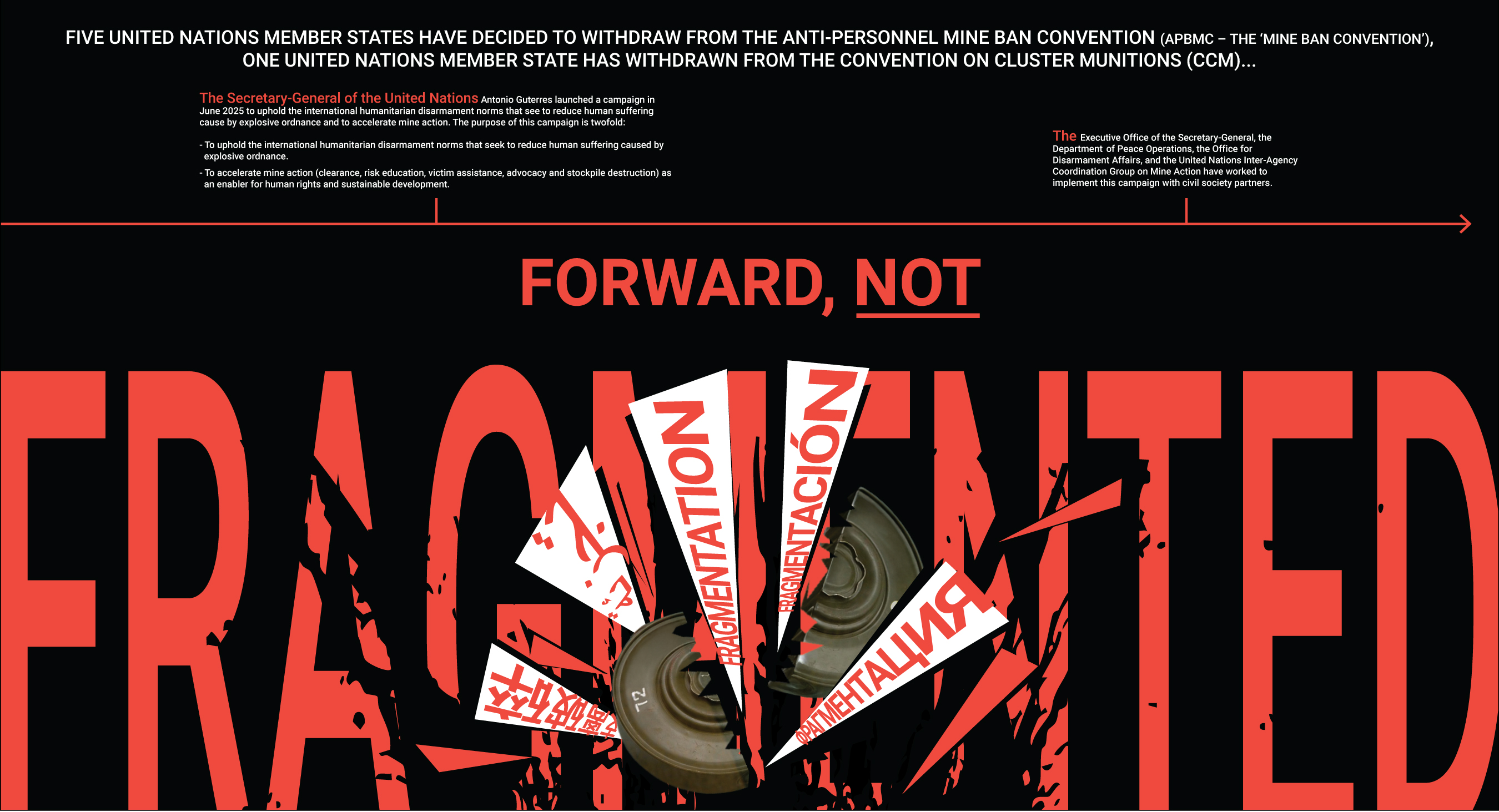

At a time when CIVILIANS FACE HEIGHTENED RISKS from widening conflicts, it is imperative that we strengthen the frameworks that protect human life and dignity. I am gravely concerned by recent announcements and steps taken by several MEMBER STATES TO WITHDRAW FROM THE ANTI-PERSONNEL MINE BAN CONVENTION.
These announcements are particularly troubling, as it RISKS WEAKENING CIVILIAN PROTECTION and undermines two decades of a normative framework that has saved countless lives. I urge all States to adhere to humanitarian disarmament treaties and immediately halt any steps towards their withdrawal.”
— António Guterres, Secretary-General of the United Nations


In 2024,
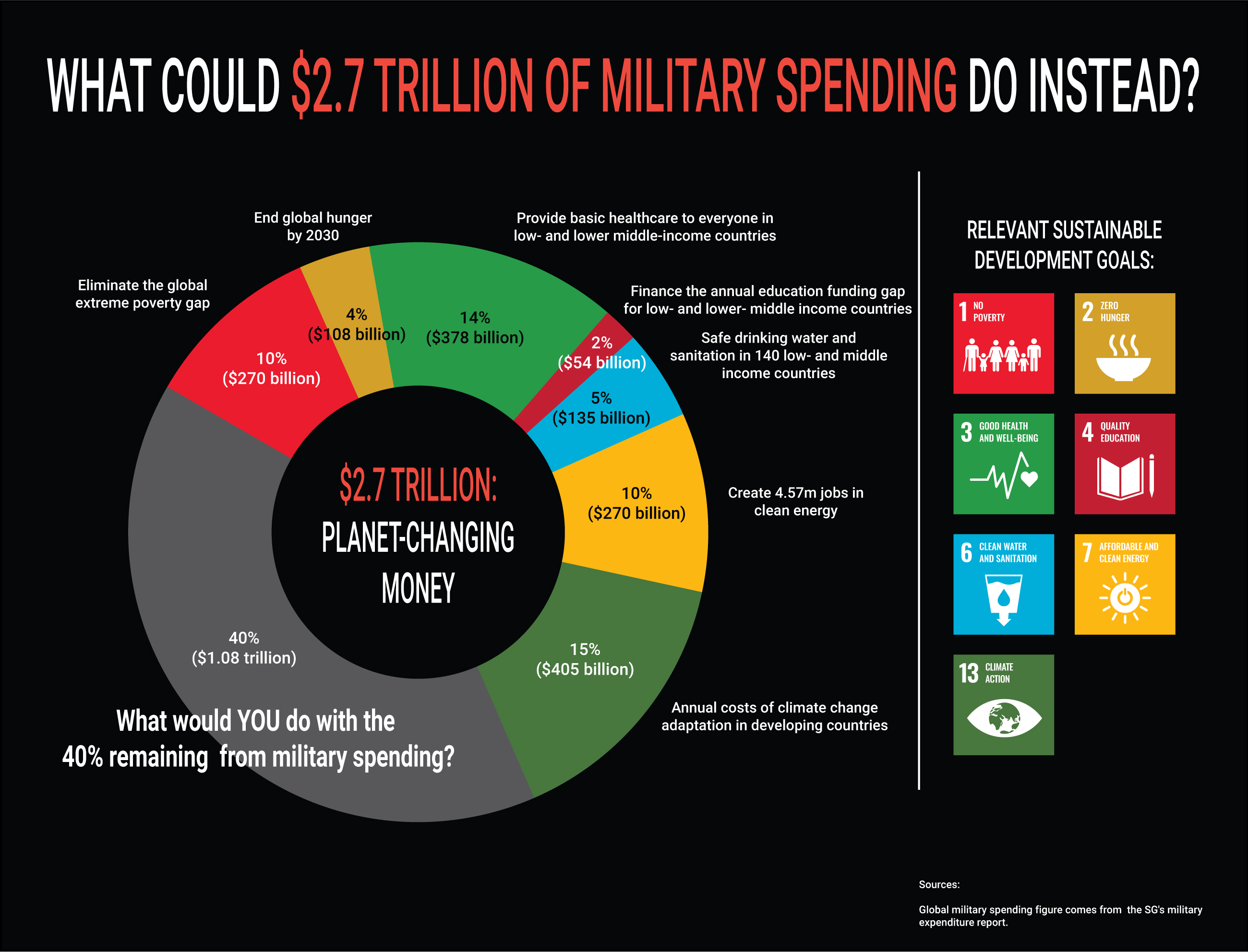
Global Military Spending was $2.7 trillion.
The UN Budget was $9.2 billion
Today's complex global landscape is increasingly defined by escalating military budgets. Global military spending reached a record high of $2.7 trillion in 2024, representing a decade of continuous growth.
Projections indicate that global military spending could reach unprecedented levels - up to $6.6 trillion by 2035 - underscoring a trajectory of continued militarization with potentially far-reaching implications. Read the Report
LATEST STATEMENTS FROM MEMBER STATES
The Anti-Personnel Mine Ban Convention and Cluster Munition Convention are global success stories.
They have greatly benefitted many communities affected by armed conflict around the world, contributed by saving lives and limbs, to protecting civilians and reducing harm. The Conventions have been instrumental for the clearance of hundreds of square kilometres of contaminated land, the destruction of items of unexploded remnants, the implementation of risk education and assistance to victims, and for mobilizing innovative schemes for cooperation and assistance.
We reiterate our countries‘ unwavering commitment to end the suffering caused by anti-personnel mines and cluster munitions that cause unacceptable harm to civilians.
The international community came together to prohibit anti-personnel mines and cluster munitions through international Conventions because of their indiscriminate effects and their short and long term humanitarian consequences that outweigh any military utility of these weapons. In light of recent developments, we unequivocally commit to uphold the Conventions, which apply to us.
We call on all States to collectively progress towards a world free of anti-personnel mines and cluster munitions including by acceding to the Conventions, where possible, without delay and we call on all States Parties to the Anti-Personnel Mine Ban Convention and Cluster Munitions Convention to collectively promote the Conventions. Let us uphold, protect, and advance the Conventions.
We express our appreciation and support to survivors and their representative organizations, to humanitarian actors and to all stakeholders that have put their tireless efforts into mine action. We must remember that the collective effort that led to the Conventions was underpinned by the need to fulfill the rights and meet the needs of survivors, affected families and communities, and to protect future generations.
Joint Message by Austria, Belgium, Colombia, Ireland, New Zealand, Norway, Mexico, Panama, Peru, Switzerland, Thailand on the occasion of the International Day on Mine Awareness and Mine Action Assistance at the 28th International Meeting of Mine Action National Directors and United Nations Advisers
The pioneering Convention under discussion today represents our solemn commitment to end the legacy of destruction from landmines. For 25 years, it has driven important progress, with over 55 million anti-personnel devices destroyed across 13,000 square kilometers in over 60 countries, and thousands of people receiving lifesaving awareness education and victim assistance services”.
— Secretary-General António Guterres, statement to the Fifth Review Conference of the Mine Ban Convention, Siem Reap, Cambodia November 2024.
1997

In Ottawa, Canada, 122 states sign the Anti-Personnel Mine Ban Convention (APMBC), banning anti-personnel mines and requiring their destruction and clearance.
2007

A decade later, 155 states are party to the convention, with many destroying stockpiles and some, like Costa Rica, Honduras, and Guatemala, declared mine-free.
2025
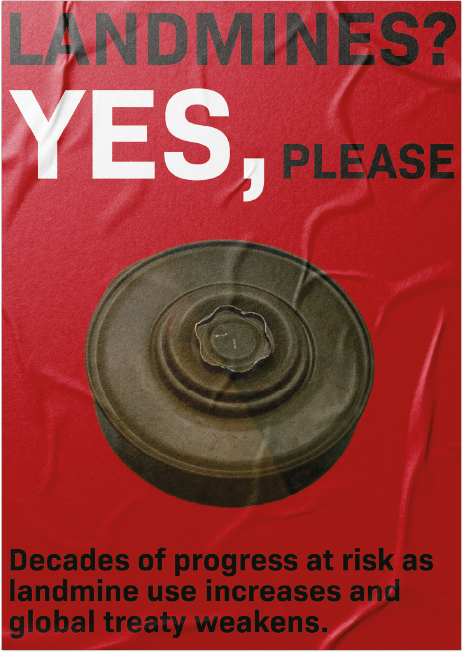
Amid rising global conflict, landmine mitigation faces a critical turning point as some countries move to withdraw from the convention.
2030+
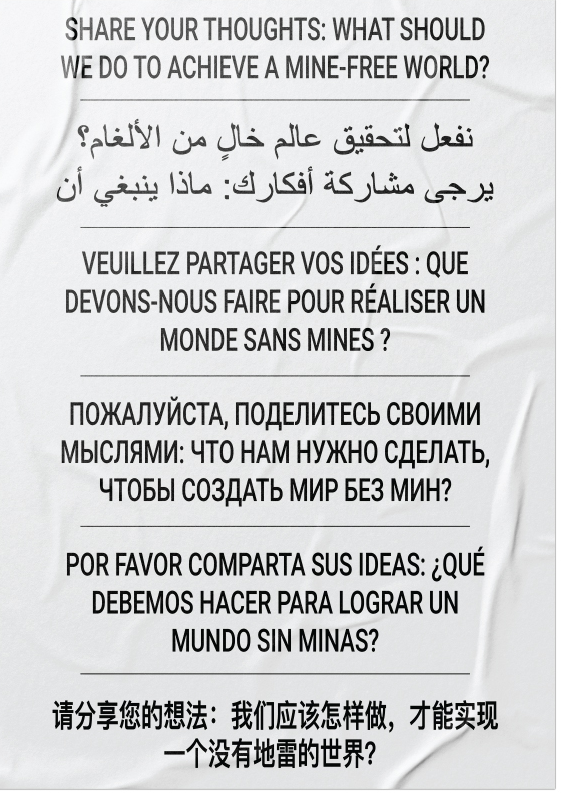
?????
"Do you see the importance?" highlights humanitarian disarmament norms and the need to protect civilians, and children, from the threat of landmines. Each page features a real excerpt from the Anti-Personnel Mine Ban Convention (Ottawa Convention), highlighted in red, alongside a drawing of a child and a short fictional story inspired by real people. These stories reflect the devastating impact of landmines. This creative project is part of the United Nations Secretary-General's 2025 campaign on mine action, which aims to uphold humanitarian disarmament norms and protect civilians from the threat of landmines. The goal is to show that withdrawing from the Convention means turning away from child victims and risking many more to come.
STOP
do you see the importance?
We were walking to the market. My daughter held my hand.
She was telling me about her schoolwork, she always loved to talk.
I let go for just a moment. She stepped ahead.
Then came the sound. And the dust. And the silence.
I ran to her. But her voice was gone.
She didn’t move. They told me it was a landmine.
Left behind. Planted in soil we still walk on.
Now I walk alone.
And sometimes, I reach for a hand that’s not there.
Amina. Borno State, Nigeria
And sometimes, I reach for a hand that’s not there.


Amina Azimi, 25, is a journalist in Afghanistan. She lost her leg to a landmine-related incident at 8 years old. UN Photo/Marco Grob

Harum Ali was seriously injured by an unexploded artillery shell in North Darfur. UN Photo/Albert Gonzalez Farran

Deminer - South Sudan, Photo: Marco Grob (UNMAS)

Wares Khan, deminer with UNMAS in Afghanistan; destroyer of mines. Photo: Marco Grob (UNMAS)


DO NOT SPARK A DANGEROUS RACE TO THE BOTTOM...
Anti-personnel landmines are among the cruelest and most indiscriminate weapons ever created. They kill and maim long after conflicts end. But in 1997, world leaders met in Ottawa to sign the Anti-Personnel Mine Ban Convention. There they pledged to protect human life – and vowed that humanitarian norms must never yield to military objectives. Yet today, as conflicts rage, some States waver in their commitment [to the Anti-Personnel Mine Ban Convention]. So let’s be clear: Any weakening of the Ottawa Convention could spark a dangerous race to the bottom...”
— António Guterres, Secretary-General of the United Nations
ICBL
The International Campaign to Ban Landmines -Cluster Munitions (ICBL-CMC) is a global network of civil society organizations working towards the elimination of these indiscriminate weapons. They played a key role in the successful negotiation and adoption of the Mine Ban Treaty, and were awarded the Nobel Peace Prize in 1997.

Courtesy of ICBL
UNITY

Courtesy of ICBL
for mine action
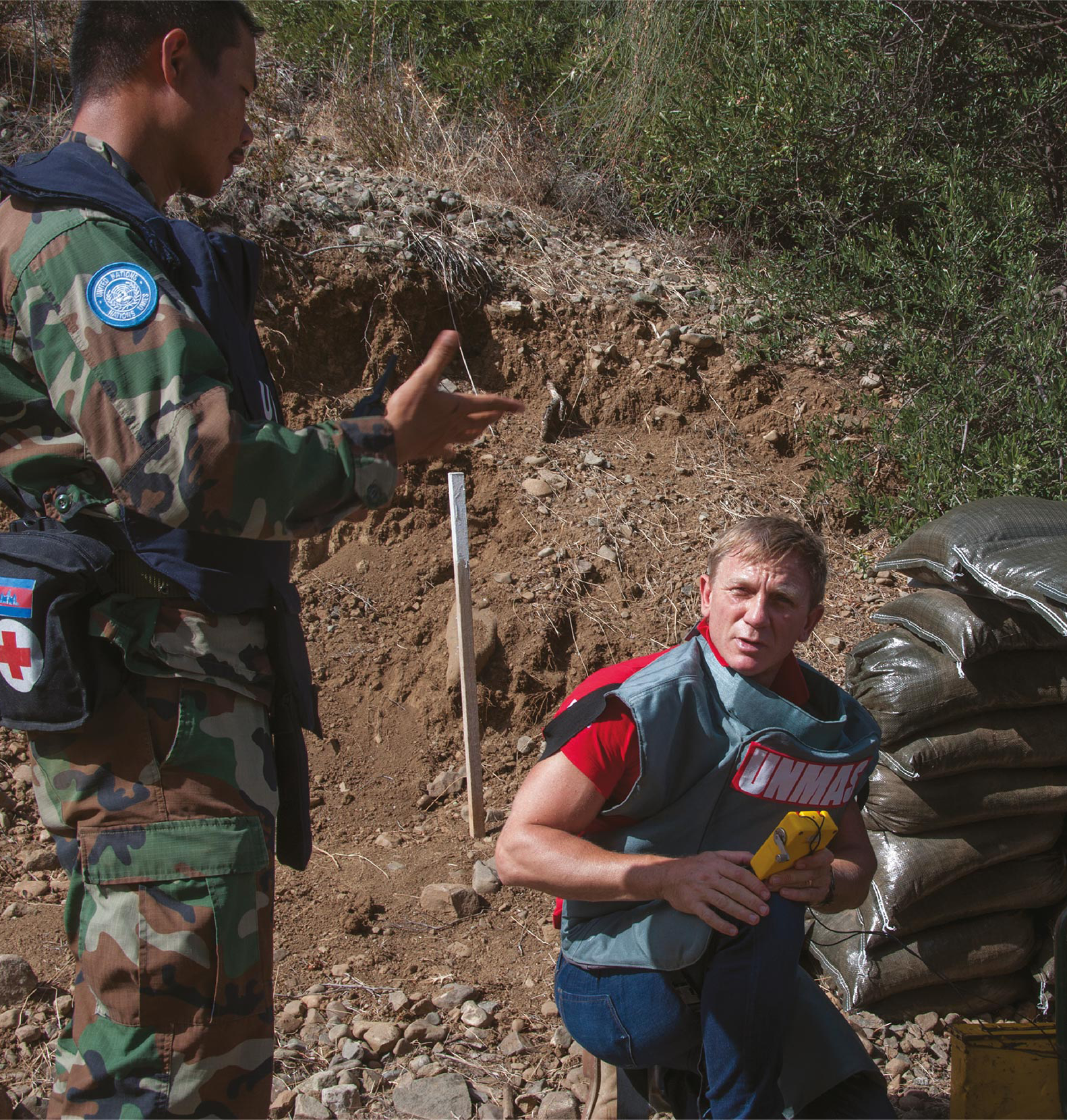
Daniel Craig, former UNMAS Global Ambassador, in Cyprus. Photo: UNMAS

Lady Diana walks through a landmine-affected area in Angola to raise awareness about the issue. Photo: HALO Trust

Legacy of War
Mr. Giles Duley is a documentary photographer, writer and storyteller. His work focuses on the long-term humanitarian impact of conflict. He captures the strength of those who fight adversity rather than succumb to it and his photographs draw the viewer to the subject, creating intimacy and empathy for lives different from ours only in circumstance.
Mr. Giles Duley was nominated by the United Nations Secretary-General in 2022 and accepted to become the first United Nations Global Advocate for Persons with Disabilities in Conflict and Peacebuilding Situations. He took up this three-year posting on 3 December 2022 at a ceremony in Kyiv, Ukraine where he was working at the time in his role as CEO of the charity, Legacy of War Foundation.
In 2023, Duley, took on a number of engagements on behalf of the United Nations, and he advocated without rest for more to be done for persons with disabilities in all settings, but specifically in conflict and post-conflict settings.
In 2024, Duley advocated for the more purposeful implementation of Security Council resolution 2475. The five-year commemoration of this resolution (June 2019) was noted in an Arria-formula meeting sponsored by Slovenia and Guyana and co-sponsored by Poland and the United Kingdom on 6 December 2024.
Duley travelled more than he was home in 2024 and spent months in Ukraine, covering the war and seeking practical assistance for persons with disabilities in that country, and in many other countries and territories. Mr. Duley advocated for the recommendations from the final report (A/78/174 - 2023) of Mr. Gerard Quinn, the Special Rapporteur for persons with disabilities 2021 - 2023.
We thank Giles Duley for his service as the First UN Global Advocate for Persons with Disabilities in Conflict and Peacebuilding Situations (3 Dec 2022 – 2 Dec 2025).
Stories of Resilience by Giles Duley
NAWALI, 24, CHAD - 2024

In Adre camp in Chad, Nawali shelters from the heat and dust. Back in South Sudan, she had been using a wheelchair and hand-driven tricycle since she was paralysed at three from malaria. When the Janjaweed, a Sudanese Arab militia group connected to the RSF, attacked her village last year, they burnt down her house and stole her tricycle. She had to crawl to safety.
Since arriving at the camp Nawali has not been provided with a wheelchair, so rarely leaves her tent. To get to the toilet, she must drag herself across the ground. Not only is this humiliating for her, it also leaves her incredibly vulnerable. “But I am not worried about myself, ” Nawali tells me. “I’m worried about my grandmother – she’s too old. And she needs things to be better, [have] better food to eat and shelter. But we have nothing.”
Since 2023 more than one million people have fled to eastern Chad to escape conflict and famine. Over 60% are children. With less than a fifth of Chad’s 2025 Humanitarian Response Plan funded, they face shortages of food and water, cuts to essential services, and the spread of cholera within camps.


IVANA, 3, LEBANON - 2024

Ivana and her sister were playing outside their house in Deir Kanoun al Naher when an Israeli guided bomb hit a garage on the other side of the street. There had been no warning.
Their parents, Fatima and Mohammad, ran out into the street to find both children severely burnt. Paramedics rushed the children to the nearest hospital. When she got there, Fatima at first didn’t recognise Ivana due to the severity of her injuries - she had third-degree burns across more than 35% of her body - but when she heard her crying, she knew it was her daughter. Both children have recovered well, though Ivana still has many months of rehabilitation and further surgeries ahead.


MOHAMMAD, 18, AFGHANISTAN - 2021

In a hospital run by the Italian medical NGO EMERGENCY - just days before the USA’s sudden withdrawal from Kabul - Mohammad beckons us over. He wants us to include his portrait. He was hit in the head by a bullet in Ghazni, and now his speech is slow and slurred. Our translator, a former nurse from the hospital, offers to fill in the photographic consent form, but Mohammad says no. It takes him 20 minutes to write his name, each stroke of the pen a battle against his injury. He finishes, then stares unflinching into my camera’s lens.
The Costs Of War project by researchers at Brown University has estimated the full cost of the 20-year conflict in Afghanistan as being $2.26tn. For the cost of the war, we could have given every Afghan more than $40,000. Instead, we have left almost 50,000 Afghan civilians dead, hundreds of thousands - like Mohammad - with disabilities and millions displaced.


JULIA, 32, UKRAINE - 2024

Julia is 32 and has cerebral palsy. When her village in southern Ukraine was occupied by Russian forces, her parents - a teacher and a mayor - were targeted and harassed. One day, they were taken in for questioning.
When her mother returned, the soldiers in the house smiled and told them, don’t worry, we looked after your daughter and gave her sweets. Julia was in bed naked, sweet wrappers on her bed sheets. Since then, she’s grown more anxious. She refuses to eat. Her teeth have begun to fall out, and her hair has thinned.
The situation in their region has deteriorated further since we last visited - there’s a constant threat of drone strikes, and little humanitarian aid now reaches them. But her family are reluctant to leave their home and community, and worried about how they could safely evacuate Julia due to her disability.


These testimonials do not necessarily reflect the views of the United Nations or its Member States.
NOBEL LAUREATES MOBILIZING AGAINST LANDMINES
30 May, 2025
We are deeply concerned by disturbing developments that are again putting civilians at greater risk of harm from antipersonnel landmines and explosive remnants of war, notably cluster munitions. These deadly weapons have effects that are far more harmful than any war benefit...
SIGNATORIES:
- Aaron Ciechanover (Chemistry)
- Albert Fert (Physics)
- Alan Heeger (Chemistry)
- Amnesty International (Peace)
- American Friends Service Committee (Peace)
- Andre Geim — Андре́й Константи́нович Гейм (Physics)
- Andrew Z. Fire (Medicine)
- Anne L’Huillier (Physics)
- Arthur B. McDonald (Physics)
- Barry Clark Barish (Physics)
- Barry J. Marshall (Medicine)
- Brian D. Josephson (Physics)
- Brian K. Kobilka (Chemistry)
- Center for Civil Liberties — Центр громадянських свобод (Peace)
- Charles M. Rice (Medicine)
- Christopher A. Pissarides — Χριστόφορος Αντωνίου Πισσαρίδης (Economics)
- Craig C. Mello (Medicine)
- Daron Acemoglu — Տարոն Աջեմօղլու (Economics)
- David J. Gross (Physics)
- David J. Wineland (Physics)
- David W. C. MacMillan (Chemistry)
- Denis Mukwege (Peace)
- Dmitry Muratov —Дмитрий Андреевич Муратов (Peace)
- Drew Weissman (Medicine)
- Edvard Moser (Medicine)
- Elfriede Jelinek (Literature)
- Eric R. Kandel (Medicine)
- Erwin Neher (Medicine)
- Ferenc Krausz (Physics)
- Finn E. Kydland (Economics)
- Geoffrey E. Hinton (Physics)
- Gerardus ’t Hooft (Physics)
- Gerhard Ertl (Chemistry)
- Giorgio Parisi (Physics)
- Gregg L. Semenza (Medicine)
- H. David Politzer (Physics)
- H. Robert Horvitz (Medicine)
- Hiroshi Amano — 天野 浩 (Physics)
- International Campaign to Abolish Nuclear Weapons (Peace)
- International Campaign to Ban Landmines (Peace)
- International Peace Bureau (Peace)
- International Physicians for the Prevention of Nuclear War (Peace)
- Jack W. Szostak (Medicine)
- J. Georg Bednorz (Physics)
- Jean-Pierre Sauvage (Chemistry)
- Jerome I. Friedman (Physics)
- Joachim Frank (Chemistry)
- Johann Deisenhofer (Chemistry)
- John C. Mather (Physics)
- Jody Williams (Peace)
- José Ramos-Horta (Peace)
- Juan Manuel Santos (Peace)
- Jules A. Hoffmann (Medicine)
- Kailash Satyarthi (Peace)
- Konstantin Novoselov — Константи́н Серге́евич Новосёлов (Physics)
- Kurt Wüthrich (Chemistry)
- Lech Walesa — Lech Wałęsa (Peace)
- Leland H. Hartwell (Medicine)
- Leymah Roberta Gbowee (Peace)
- Louis J. Ignarro (Medicine)
- Mario R. Capecchi (Medicine)
- May-Britt Moser (Medicine)
- Michael Levitt (Chemistry)
- Michael Rosbash (Medicine)
- Michel Mayor (Physics)
- Narges Mohammadi (Peace)
- Orhan Pamuk (Literature)
- Oscar Arias Sánchez (Peace)
- Patrick Modiano (Literature)
- Paul L. Modrich (Chemistry)
- Peter C. Doherty (Medicine)
- Richard Henderson (Chemistry)
- Robert J. Lefkowitz (Chemistry)
- Roald Hoffmann (Chemistry)
- Roger D. Kornberg (Chemistry)
- Roger Penrose (Physics)
- Shirin Ebadi (Peace)
- Sheldon Glashow (Physics)
- Sir M. Stanley Whittingham (Chemistry)
- Sir Michael Houghton (Medicine)
- Sir Oliver Hart (Economics)
- Sir Paul M. Nurse (Medicine)
- Sir Peter J. Ratcliffe (Medicine)
- Stanley B. Prusiner (Medicine)
- Steven Chu — 朱棣文 (Physics)
- Takaaki Kajita — 梶田 隆章 (Physics)
- Tawakkol Karman — توكل كرمان (Peace)
- The 14th Dalai Lama (Tenzin Gyatso) — བསྟན་-འཛིན་-རྒྱ་-མཚོ་ (Peace)
- Tomas Lindahl (Chemistry)
- Venkatraman Ramakrishnan —வெங்கட்ராமன் ராமகிருஷ்ணன் (Chemistry)
- Victor Ambros (Medicine)
- William C. Campbell (Medicine)
- William E. Moerner (Chemistry)
- Wolfgang Ketterle (Physics)
- Wole Soyinka — Akinwándé Olúwolé Babátúndé Ṣóyíinká (Literature)
- Yuan T. Lee — 李遠哲 (Chemistry)

Small Feet, Big Fears: Why We Must Ban Landmines
From Fear to Freedom: Why Mine Action Matters?
International Campaign to Ban Landmines (ICBL)
This exhibit was launched in December 2025