
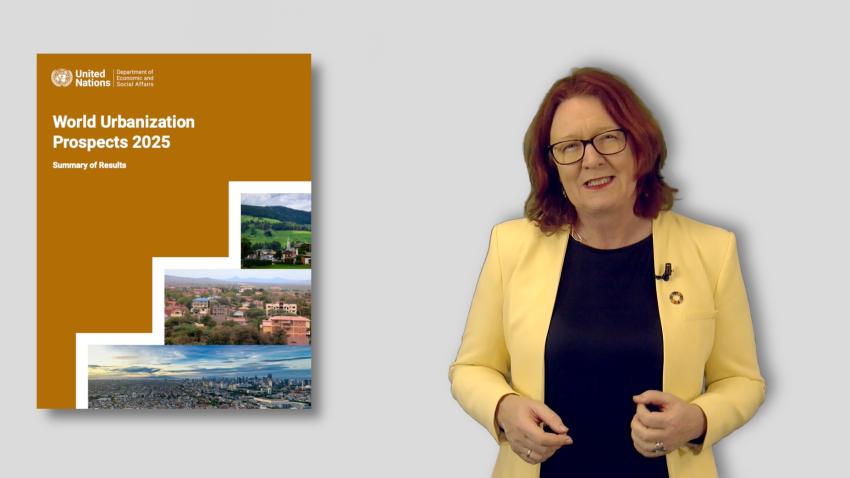
1 December 2025 – Our world is becoming increasingly urban. Cities are now home to 45 per cent of the global population of 8.2 billion, according to UN DESA’s World Urbanization Prospects 2025: Summary of Results, released on 18 November 2025.
The number of people living in cities has more than doubled since 1950, when only 20 per cent of the world’s 2.5 billion people lived in cities. Looking ahead through 2050, two-thirds of global population growth is projected to occur in cities, and most of the remaining one-third in towns.
The number of megacities, urban areas with 10 million or more inhabitants, has quadrupled from 8 in 1975 to 33 in 2025. Over half of these (19) are in Asia.
Jakarta (Indonesia) is now the world’s most populous city, with nearly 42 million residents, followed by Dhaka (Bangladesh) with almost 40 million, and Tokyo (Japan) with 33 million. Cairo (Egypt) is the only non-Asian city among the top ten. By 2050, the number of megacities is expected to rise to 37, with cities such as Addis Ababa (Ethiopia), Dar es Salaam (United Republic of Tanzania), Hajipur (India), and Kuala Lumpur (Malaysia) projected to surpass the 10 million mark.
Despite the prominence of megacities, the report finds that small and medium-sized cities are home to more people than megacities and are growing at a faster pace, particularly in Africa and Asia. The report also highlights the divergent growth patterns of cities. While many cities continue to expand, others are experiencing population decline.
Towns, defined as population clusters of at least 5,000 inhabitants and a density of at least 300 people per square kilometer, are the most common settlement type in 71 countries as diverse as Germany, India, Uganda, and the United States. They play a vital role in connecting rural areas and cities, offering essential services and supporting local economies. Rural areas on the other hand, remain the most common settlement type in 62 countries today, down from 116 in 1975. By 2050, this number is projected to decline further to 44 countries. Sub-Saharan Africa is the only region where rural populations have continued to grow significantly, and the region is expected to account for nearly all future rural population growth.
“Sustainable development depends on seeing cities, towns and rural areas as one interconnected system. We need to proactively plan to develop different areas evenly and ease pressure on large cities,” said UN DESA’s Assistant Secretary-General for Policy Coordination Bjørg Sandkjær.
“The World Urbanization Prospects report gives us the data and insights we need to plan for that shared future,” Ms. Sandkjær said, referring to the report’s role in providing a critical evidence base for policymakers, planners, and researchers working to shape sustainable, inclusive, and resilient urban futures.
The 2025 edition also introduces major methodological innovations. For the first time, it integrates the Degree of Urbanization, a harmonized geospatial approach that provides projections for three categories of settlements: cities, towns, and rural areas. This new approach enhances international comparability and offers a more nuanced understanding of urbanization trends.
All materials related to the World Urbanization Prospects 2025, including the summary report and the complete dataset, are available at population.un.org.