
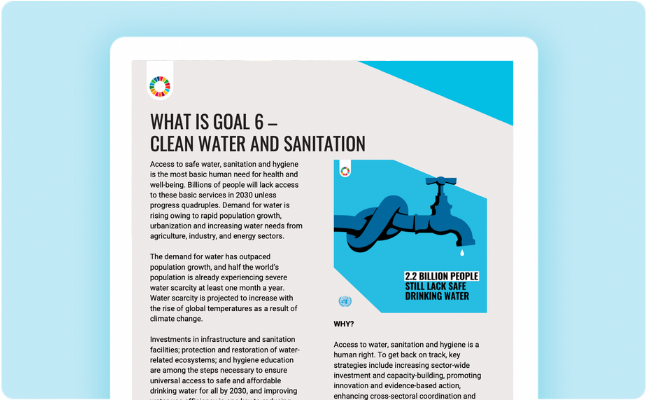
Access to safe water, sanitation and hygiene is the most basic human need for health and well-being. Billions of people will lack access to these basic services in 2030 unless progress quadruples. Demand for water is rising owing to rapid population growth, urbanization and increasing water needs from agriculture, industry, and energy sectors.
The demand for water has outpaced population growth, and half the world’s population is already experiencing severe water scarcity at least one month a year. Water scarcity is projected to increase with the rise of global temperatures as a result of climate change.
Investments in infrastructure and sanitation facilities; protection and restoration of water- related ecosystems; and hygiene education are among the steps necessary to ensure universal access to safe and affordable drinking water for all by 2030, and improving water-use efficiency is one key to reducing water stress.
There has been positive progress. Between 2015 and 2022, the proportion of the world’s population with access to safely managed drinking water increased from 69 per cent to 73 per cent.
Why?
Access to water, sanitation and hygiene is a human right. To get back on track, key strategies include increasing sector-wide investment and capacity-building, promoting innovation and evidence-based action, enhancing cross-sectoral coordination and cooperation among all stakeholders, and adopting a more integrated and holistic approach to water management.
Water is essential not only to health, but also to poverty reduction, food security, peace and human rights, ecosystems and education.
Nevertheless, countries face growing challenges linked to water scarcity, water pollution, degraded water-related ecosystems and cooperation over transboundary water basins.
What are the challenges?
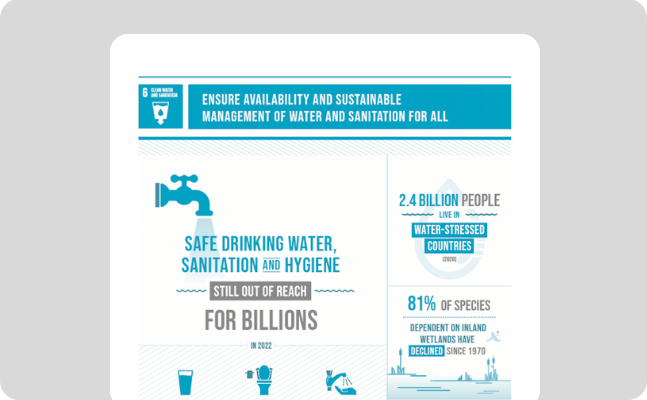
In 2022, 2.2 billion people still lacked safely managed drinking water, including 703 million without a basic water service; 3.5 billion people lacked safely managed sanitation, including 1.5 billion without basic sanitation services; and 2 billion lacked a basic handwashing facility, including 653 million with no handwashing facility at all.
By managing our water sustainably, we are also able to better manage our production of food and energy and contribute to decent work and economic growth. Moreover, we can preserve our water ecosystems, their biodiversity, and take action on climate change.
Are water and climate change linked?
Water availability is becoming less predictable in many places. In some regions, droughts are exacerbating water scarcity and thereby negatively impacting people’s health and productivity and threatening sustainable development and biodiversity worldwide.
Ensuring that everyone has access to sustainable water and sanitation services is a critical climate change mitigation strategy for the years ahead.
Without better infrastructure and management, millions of people will continue to die every year from water-related diseases such as malaria and diarrhoea, and there will be further losses in biodiversity and ecosystem resilience, undermining prosperity and efforts towards a more sustainable
What can we do?
Civil society organizations should work to keep governments accountable, invest in water research and development, and promote the inclusion of women, youth and indigenous communities in water resources governance.
Generating awareness of these roles and turn- ing them into action will lead to win-win results and increased sustainability and integrity for both human and ecological systems.
You can also get involved in the World Water Day and World Toilet Day campaigns that aim to provide information and inspiration to take action on hygiene issues.
- Despite great progress, billions of people still lack access to safe drinking water, sanitation and hygiene. Achieving universal coverage by 2030 will require a substantial increase in current global rates of progress: sixfold for drinking water, fivefold for sanitation and threefold for hygiene.
- Water use efficiency has risen by 9 per cent, but water stress and water scarcity remain a concern in many parts of the world. In 2020, 2.4 billion people lived in water-stressed countries. The challenges are compounded by conflicts and climate change.
- Key strategies to get Goal 6 back on track include increasing sector-wide investment and capacity-building, promoting innovation and evidence- based action, enhancing cross-sectoral coordination and cooperation among all stakeholders, and adopting a more integrated and holistic approach to water management.
- Only 0.5 per cent of water on Earth is useable and available freshwater – Wake up to the looming water crisis, report warns | World Meteorological Organization
- Limiting global warming to 1.5°C compared to 2°C would approximately halve the proportion of the world population expected to suffer water scarcity, although there is considerable variability between regions.Chapter 8: Water Cycle Changes (p. 1063)
- The global urban population facing water scarcity is projected to double from 930 million in 2016 to 1.7–2.4 billion people in 2050. Imminent risk of a global water crisis, warns the UN World Water Development Report 2023 | UNESCO
- Despite progress, 2.2 billion people still lacked safely managed drinking water services, 3.5 billion lacked safely managed sanitation services, and 2.0 billion lacked basic hygiene services in 2022
- Surface water bodies, such as lakes, rivers, and reservoirs, are undergoing rapid global changes, with one in five river basins showing high fluctuations in surface water levels in the past 5 years
- Water pollution poses a significant challenge to human health and the environment in many countries.
6.1 By 2030, achieve universal and equitable access to safe and affordable drinking water for all
6.2 By 2030, achieve access to adequate and equitable sanitation and hygiene for all and end open defecation, paying special attention to the needs of women and girls and those in vulnerable situations
6.3 By 2030, improve water quality by reducing pollution, eliminating dumping and minimizing release of hazardous chemicals and materials, halving the proportion of untreated wastewater and substantially increasing recycling and safe reuse globally
6.4 By 2030, substantially increase water-use efficiency across all sectors and ensure sustainable withdrawals and supply of freshwater to address water scarcity and substantially reduce the number of people suffering from water scarcity
6.5 By 2030, implement integrated water resources management at all levels, including through transboundary cooperation as appropriate
6.6 By 2020, protect and restore water-related ecosystems, including mountains, forests, wetlands, rivers, aquifers and lakes
6.A By 2030, expand international cooperation and capacity-building support to developing countries in water- and sanitation-related activities and programmes, including water harvesting, desalination, water efficiency, wastewater treatment, recycling and reuse technologies
6.B Support and strengthen the participation of local communities in improving water and sanitation management
World Water Assessment Programme
UNDP Water and Ocean Governance
UN-HABITAT Water and Sanitation
A Post-2015 Global Goal for Water: Recommendations from UN-Water
Water and Sustainable Development Goals
Information briefs on water and sustainable development
UN-Water Decade Programme on Advocacy and Communication
Water Action Decade, 2018-2028
40 per cent shortfall in freshwater resources by 2030 coupled with a rising world
population has the world careening towards a global water crisis. Recognizing the growing challenge of water scarcity the UN General Assembly launched the Water Action Decade on 22 March 2018, to mobilize action that will help transform how we manage water.
Related news
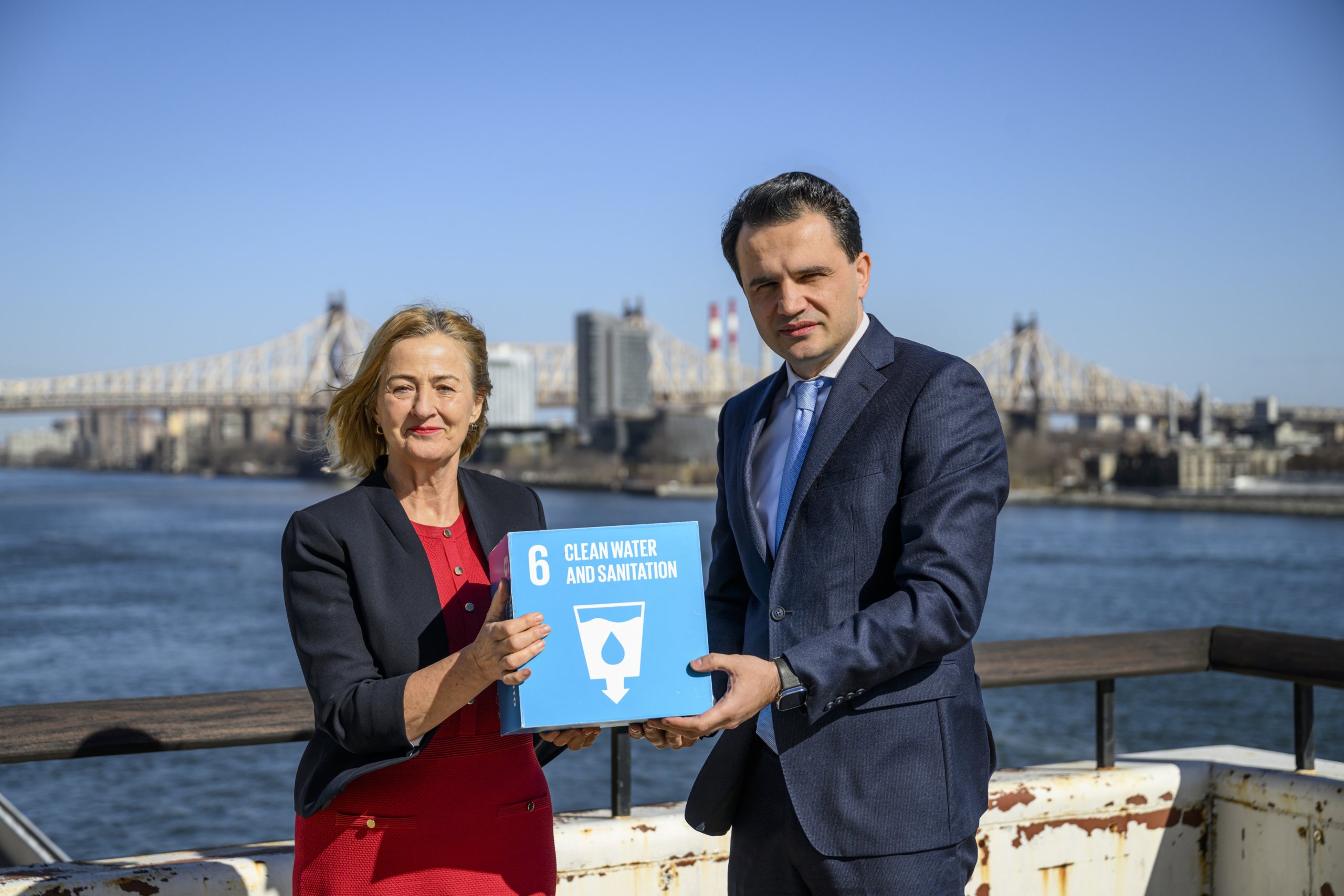
INTERVIEW: Turn the tide on water crisis with game-changing commitments, urge co-hosts of UN conference
Water is life, yet this vital natural resource is being depleted, polluted and mismanaged. Disruption to the hydrological cycle is also causing more water-related disasters. To tackle the challenges, the United Nations will convene in [...]
UN 2023 Water Conference
In March 2023, the world will come together to address the urgent water crisis at the UN 2023 Water Conference in New York. Co-hosted by the Kingdom of the Netherlands and the Republic of [...]
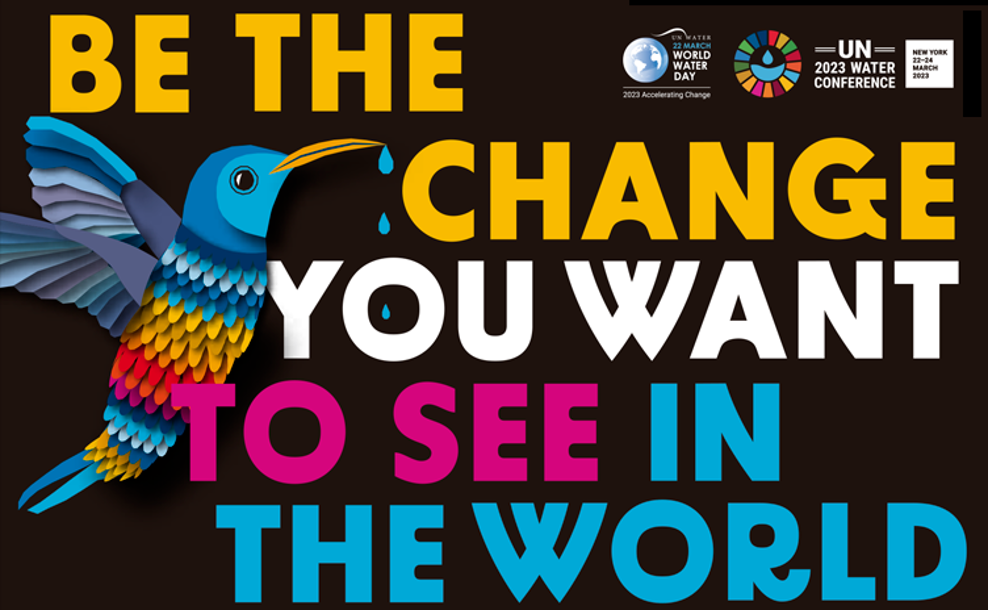
Ancient tale of hummingbird inspires UN World Water Day campaign
16 January, GENEVA – Inspired by an ancient tale of a hummingbird trying to put out a forest fire, the United Nations has kicked off a World Water Day 2023 campaign that calls on [...]
Related videos
WATCH: How we treat our waste affects our health, environment and even our economies
"Mottainai!" is a Japanese term for "what a waste!" Watch this UN Environment video to see how living more sustainably saves literally tonnes of waste.