
Progress toward quality education was already slower than required before the COVID-19 pandemic further stalled gains. Global school completion rates have risen only modestly since 2015, and overall learning proficiency remains low. As of 2024, 273 million children and youth were out of school—a 3% increase since 2015—with the largest concentration in low-income countries.
Education is the cornerstone that allows us to achieve many other Sustainable Development Goals. When people have access to quality education, they can finally break free from the cycle of poverty. Beyond securing free primary and secondary schooling for all boys and girls by 2030, Goal 4 aims to provide equal access to affordable vocational training, eliminate gender and wealth disparities, and ensure universal access to quality higher education.
Education reduces inequalities, drives gender equality, and empowers people to live healthier, more sustainable lives. It is also crucial for fostering tolerance and building peaceful societies. To deliver on Goal 4, education financing must become a top national investment priority, supported by measures like making education free and compulsory, increasing the number of teachers, improving basic school infrastructure, and embracing digital transformation.
What progress have we made so far?
While we are making headway toward the UN’s 2030 education targets, consistent effort is still needed to ensure quality education is accessible to everyone. Between 2015 and 2024, the primary school completion rate increased from 85% to 88%, lower secondary completion rose from 74% to 78%, and upper secondary completion grew from 53% to 60%. However, regional gaps remain stark, as only two in three children in sub-Saharan Africa complete primary school on time.
What challenges remain?
In 2019, only 58% of children achieved minimum reading proficiency, and just 44% reached minimum mathematics proficiency by the end of primary school. Between 2018 and 2022, learning outcomes for lower-secondary students declined further, dropping by 15 points in mathematics and 10 points in reading.
Teacher quality is also a growing concern. In 2024, about one in five teachers worldwide still did not meet minimum national qualification standards. While qualified primary teachers rose slightly to 82% between 2015 and 2024, secondary teacher qualification levels experienced a slight decline over the same period, with the steepest drops in sub-Saharan Africa, Latin America, and the Caribbean.
Basic school services are also slow to improve. Globally, only half of primary schools have basic infrastructure to support students with disabilities, which disproportionately impacts girls and marginalized groups. Additionally, low levels of information and communications technology (ICT) skills remain a massive barrier to meaningful digital connectivity.
Where are people struggling the most to have access to education?
Least developed countries face the greatest challenges in equipping schools with basic resources. The situation is critical at the primary level, where up to half of all schools lack basic sanitation, more than half lack electricity, and over two-thirds are without digital tools. These inequalities will only worsen unless we actively close the digital divide.
Are there groups that have more difficult access to education?
Yes, women and girls continue to face significant disadvantages. About 40% of countries have not yet achieved gender parity in primary education. These educational gaps directly translate to a lack of skills and limited opportunities in the labor market for young women later in life.
Furthermore, while the median Internet usage rate across countries stands at 92%, many users still lack the digital literacy to critically assess information and protect themselves online. As artificial intelligence transforms both classrooms and workplaces, strengthening basic digital skills and critical thinking will be essential to ensure inclusive participation in the digital economy.
What can we do?
We can advocate for our governments to prioritize education in both policy and practice. By lobbying for firm commitments to keep education financing as a national investment priority, we can help provide free, high-quality primary and secondary schooling to all, including the most vulnerable and marginalized communities.
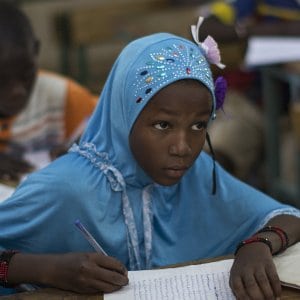
- In 2024, 273 million children and young people were out of school — about one in six globally.
- 4 in 10 countries still fall short of gender parity in primary completion rates
- Between 2015 and 2024, the global primary completion rate rose to 88 per cent, lower secondary to 78 per cent, and upper secondary to 60 per cent, yet 754 million adults remained illiterate in 2024, with women accounting for 63 per cent of the total.
- Despite a high median rate for Internet usage (92 per cent), many children and young people lack essential skills, highlighting a significant gap between access and the ability to use the Internet effectively and safely.
- Globally, more than one fifth of primary schools still lack access to electricity, safe drinking water or basic sanitation, while fewer than half have computers, Internet access or disability-adapted infrastructure.
4.1 By 2030, ensure that all girls and boys complete free, equitable and quality primary and secondary education leading to relevant and Goal-4 effective learning outcomes
4.2 By 2030, ensure that all girls and boys have access to quality early childhood development, care and preprimary education so that they are ready for primary education
4.3 By 2030, ensure equal access for all women and men to affordable and quality technical, vocational and tertiary education, including university
4.4 By 2030, substantially increase the number of youth and adults who have relevant skills, including technical and vocational skills, for employment, decent jobs and entrepreneurship
4.5 By 2030, eliminate gender disparities in education and ensure equal access to all levels of education and vocational training for the vulnerable, including persons with disabilities, indigenous peoples and children in vulnerable situations
4.6 By 2030, ensure that all youth and a substantial proportion of adults, both men and women, achieve literacy and numeracy
4.7 By 2030, ensure that all learners acquire the knowledge and skills needed to promote sustainable development, including, among others, through education for sustainable development and sustainable lifestyles, human rights, gender equality, promotion of a culture of peace and non-violence, global citizenship and appreciation of cultural diversity and of culture’s contribution to sustainable development
4.A Build and upgrade education facilities that are child, disability and gender sensitive and provide safe, nonviolent, inclusive and effective learning environments for all
4.B By 2020, substantially expand globally the number of scholarships available to developing countries, in particular least developed countries, small island developing States and African countries, for enrolment in higher education, including vocational training and information and communications technology, technical, engineering and scientific programmes, in developed countries and other developing countries
4.C By 2030, substantially increase the supply of qualified teachers, including through international cooperation for teacher training in developing countries, especially least developed countries and small island developing states

Related news
Amélie Jézabel Mariage, United Nations Young Leader for the SDGs and Co-founder of Aprendices Visuales
United Nations Young Leader for the SDGs Amélie Jézabel Mariage discusses her inspiration in advocating for children's rights to access inclusive education, adding that “innovation in education is a proven path to inclusion and a bridge to opportunity.”
Madelle Kangha, United Nations Young Leader for the SDGs and Founder of JumpStart Academy Africa
I believe that educating and empowering young people everywhere, to become effective and productive members of society, is essential for sustainable growth and development.

SDG Advocate Her Highness Sheikha Moza bint Nasser, met with Antonio Guterres and Henrietta Fore at Hamad bin Khalifa University to discuss progress on SDG 4
On 16th December 2018 SDG Advocate Her Highness Sheikha Moza bint Nasser, Founder and Chairperson of Education Above All Foundation met with the UN Secretary-General Antonio Guterres and UNICEF Executive Director, Henrietta Fore and [...]