
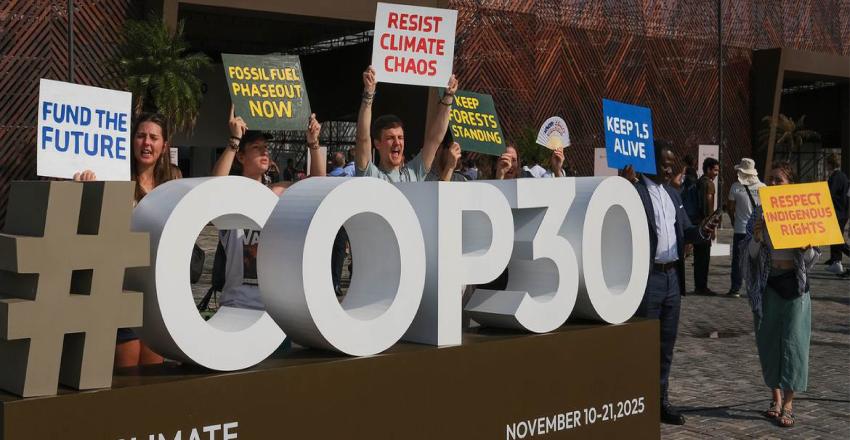
“A new economy is rising, while the old polluting one is running out of road.”
That was the message from UN climate chief Simon Stiell as COP30 wrapped up following marathon talks on Friday night which stretched into sunrise Saturday – signaling a turning point for climate ambition and global solidarity.
What was decided:
Finance at scale: Mobilise $1.3 trillion annually by 2035 for climate action.
Adaptation boost: Double adaptation finance by 2025 and triple by 2035.
Loss and damage fund: Operationalisation and replenishment cycles confirmed.
New initiatives: Launch of the Global Implementation Accelerator and Belém Mission to 1.5°C to drive ambition and implementation.
Climate disinformation: Commitment to promote information integrity and counter false narratives.
The final decision emphasises solidarity and investment, setting ambitious financial targets while leaving energy transition for later discussion. The burning of fossil fuels emits greenhouse gases that are by far the largest contributors to global warming, making this omission a point of concern for many nations, including negotiators from South America and the EU, as well as civil society groups.
Expectations were high that COP30's final decision would include explicit reference to phasing out fossil fuels. More than 80 countries backed Brazil’s proposal for a formal ‘roadmap.’
A draft text had included it – until the final hours of talks. The adopted outcome refers only to the ‘UAE Consensus’, the COP28 decision calling for “transitioning away from fossil fuels.”
Before the final plenary, Brazilian scientist Carlos Nobre issued a stark warning: fossil fuel use must fall to zero by 2040 – 2045 at the latest to avoid catastrophic temperature rises of up to 2.5°C by mid-century. That trajectory, he said, would spell the near-total loss of coral reefs, the collapse of the Amazon rainforest and an accelerated melt of the Greenland ice sheet.


