





International UN-Water Conference. Water in the Green Economy in Practice: Towards Rio+20. 3-5 October 2011
Session 8: Water planning to support the transition towards green growth
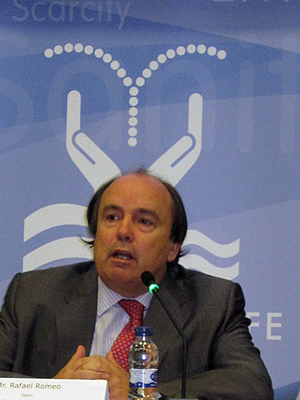 "We have to get past the perception that protecting the environment undermines economic development."
Rafael Romeo
>> Full interview
Convener: Ebro River Basin Authority (CHE)
Date: 5 October 2011
Time: 11:30 – 13:00
Place: Plenary Room
Speakers and panelists
- Overview of the session: Mr. Manuel Omedas, Head of the Plamning Office, CHE
- Discussion with panelists:
Case 1. Lao PDR: Ms. Chongchith Chantharanonh, Ministry of Natural Resources and Environment.
Case 2. Korea: Ms. Yoon-Jung Cha, Office of National River Restoration, Ministry of Land, Transport and Maritime Affairs.
Overview of the tool
This overview  introduces reforms for green jobs and explains how they can act as a tool for change in supporting the transition to a green economy. It reflects on challenges faced, how the tool helps overcome the challenges, and lessons learnt from implementation.
Cases in the Plenary
Interviewing Oudomsack Philavong, Assistant Director General, Department of Water Resources, Ministry of Natural Resources and Environment, Lao PDR
>> Full interview with Oudomsack Philavong
- Case 1: Water planning in LAO PDR
This case introduces water planning within the framework of IWRM that is a key instrument for tacking pressures on water resources in Lao. This planning framework focuses on participatory planning, and involves cooperation between riparian countries for management of the Mekong River Basin. The planning practice lead to the guarantee of maintenance and recovery of water quality through better enforcement of regulations, maintenance of the water quality and quantity flowing to the Mekong delta and reduction in floods risks.
Interviewing Yoon-Jung Cha, Office of National River Restoration, Ministry of Land, Transport and Maritime Affairs, Korea.
>> Full interview with Yoon-Jung Cha
- Case 2: The Four Major Rivers Restoration Project
This case describes a river restoration program, which is to restore the Han River, Nakdong River, Geum River and Yeongsan River to provide water security, flood control and ecosystem vitality. The project will also prevent natural disasters, such as floods and droughts, protect the environment and promote historical and cultural tourism. The project seeks to achieve, by 2012, a 90 percent increase in water quality (BOD less than 3ppm) by expanding sewage treatment facilities and establishing green algae reduction facilities. More than 929 km of national streams will be restored as part of the Four Major River Restoration Project. It is expected that the project will create 340,000 jobs and generate an estimated KRW 40 trillion of economic benefits..
Case studies table
This table includes cases presented during the conference as well as additional cases which illustrate successful implementation of the tool. These will contribute to the preparation of input for the Rio+20 conference.
>> Conference Home
>> Statements from UN Agencies
>> Video recording of sessions
>> Ch1 Water on the Road to Rio+20
>> Ch2 Challenges and opportunities for water in the transition to a GE
>> Ch3 Thematic conference papers
>> Ch4 Conference summary: Water in the GE in practice
>> Ch5 The way forward
>> A1 Water toolbox: A contribution to Rio+20
>> A2 Feedback report
>> A3 Communications report
>> Case papers by tool
>> By region
>> Developing countries
>> Developed countries
>> Agenda
>> Economic instruments
>> Green jobs
>> Sustainable financing
>> Investments for biodiversity protection
>> Water technology
>> Water planning
>> ESCWA region
>> LAC region
>> Conference daily
>> Interviews with case presenters 
>> Presentations
>> Communications articles
>> Conference media brief
>> Daily press notes
>> Interviews with session conveners
>> Issues information briefs
>> Tools information briefs
>> Banners
>> Reader on water and the Green Economy
>> Conference poster
 >> Discussion forum
 >> Twitter
>> Water, energy and food security
>> Spanish Business Dialogue
>> Stakeholder dialogue on the Green Economy in Spain
>> Technical visit
>> Organizers
>> Participants
>> Conference committee
>> Rationale
>> Tools
>> Expected outcomes
>> 2nd UNCSD PrepCom
>> Road map to Rio+20
>> Key questions on GE