UN DESA | DPAD | Development Policy Analysis Division
** This page has moved permanently. If you are not redirected please click here: https://www.un.org/development/desa/dpad/document_gem/global-economic-monitoring-unit/world-economic-situation-and-prospects-weekly-highlight/ **
World Economic Situation and Prospects
Weekly Highlights
19 May 2014
Prepared by John Winkel
Change in world trade of goods and services
Over the past decades, there has been a noticeable shift in the sources of global trade. Developing countries are exporting an increasing share of both goods and services as a fraction of total world trade. Over the period from 1998 to 2012, developing countries' share of world trade in goods and services rose from about 27 per cent to over 40 per cent, while developed countries' share fell from over 71 per cent to about 55 per cent. Accompanying that rise, there has been a slow shift in the exports of developed countries, from a greater share of their exports in goods to a greater share coming as services exports (table). While the magnitude of the change is not sizable, it is still significant as it represents structural changes which manifest gradually over the long term.
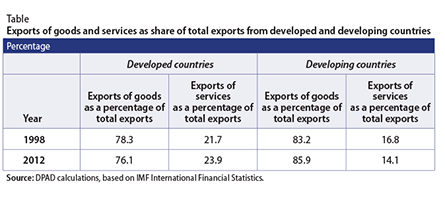
In addition, while developing countries' overall share of world services exports has been rising over the period, developed countries still dominate the services trade. World Trade Organization data on trade in commercial services points to significant services trade deficits for many major developing countries, and services trade surpluses for a number of developed countries. At the same time, services export growth has been slightly stronger than import growth in developing countries over the decade from 2000 to 2010, and both are considerably higher than the rates for developed countries.1 All of these developments come as world commercial services trade has grown considerably over the same period, from $1.3 trillion to $4.6 trillion between 1998 and 2013, and continues to grow as a share of overall world trade.
1 Michalopoulos, C. and F. Ng (2013), "Trends in Developing Country Trade 1980-2010", World Bank Policy Research Working Paper 6334, January.