The world faces a worsening series of regional and local water crises, according to a 1997 study by the United Nations and the Stockholm Environment Institute.
Overuse and pollution are limiting the amount of freshwater that is available to safely meet the needs of human society and of the ecosystem, according to the Comprehensive Assessment of the Freshwater Resources of the World, prepared for the United Nations Commission on Sustainable Development and presented to the June 1997 General Assembly Earth Summit Review. With agriculture highly dependent on access to ample freshwater resources for irrigation in addition to rainfall, qualitatively improved irrigation techniques will be necessary if there is to be enough food for the world's growing population, the study finds.
Freshwater is a fundamental resource for development, used in agriculture, industry and households. It is a resource for which there is no substitute, whether as drinking water for people and animals, for hygiene, for crops and industrial processes or for fish and aquatic life.
But the volume of current consumption can be reduced without necessarily detracting from standards of living or curtailing economic growth, and the technologies to make this possible are already available. It is largely a question of successfully adapting human activities to the exigencies of water supply. The Assessment points out that the amount of water used for intensive crop irrigation in dry areas can be reduced by purchasing food on the world market. Industrial processes can be modified to use less water, and household use -- which in any event is a small portion of overall water consumption -- can be reduced in developed countries without detracting from the quality of life. Especially in arid or semi-arid regions, low-value water-intensive economic activity needs to be progressively replaced by high-value enterprises that use smaller volumes of water.
Much of the needed improvements would be facilitated by a graduated elimination of water subsidies and by the introduction of pricing policies that take into account the costs of delivering and cleaning water for re-use as well as the needs of the poor.
The Earth is the "blue planet", with three fourths of its surface covered by water. But 97.5 per cent of that is salt water. Only 2.5 per cent is fresh, and nearly 70 per cent of the freshwater is locked in the ice sheets of Antarctica and Greenland. Much of the remainder resides in deep underground aquifers.
Freshwater comes from the water which evaporates from the ocean, at a rate of more than half a million cubic kilometres (km3) a year. Nearly 90 per cent of this evaporated water falls back into the sea as rain (see illustration below). And most of the rainfall that reaches land is evaporated before it is available for human use. The 47,000 km3 that returns to the oceans via rivers, groundwater and glaciers -- known as the global runoff -- is the amount that is theoretically available for human use.
There are further limitations on the volume of freshwater useful to people. Among these are geographical and temporal variations in precipitation -- too little rainfall in desiccated areas or during dry seasons, and too much in humid areas or during wet seasons. All in all, about 14,000 km3 is estimated to be easily available for human use. Even though this is still an impressive amount of water--weighing in at 14 trillion metric tonnes--the Assessment finds that the capacity of the hydrological cycle to supply water is being outstripped by the volume of human demands, pollution of water resources and poor water management. Moreover, freshwater is unevenly distributed over the planet, and large water diversion projects are often associated with problems in the areas where the water is used as well as in the source area. The UN study finds that many major rivers--such as the Colorado in the United States and rivers flowing into the Aral Sea -- are decreasing in volume as they flow downstream, and that use of groundwater resources is outstripping the rate of natural recharge.
Irrigation of crops accounts for nearly 90 per cent of total human consumption of freshwater resources. Although most crops are rain-fed, irrigated farmland generally is more productive -- contributing almost 40 per cent of total food production on only 17 per cent of cultivated land. The problem is that irrigation siphons off large volumes of freshwater from waterways and groundwater aquifers. Diminished river flows hurt aquatic ecosystems, and depletion of aquifers leads to lower groundwater tables, which in coastal areas may become infused with saltwater.

The hydrological cycle is the governor of freshwater, to which humans and ecosystems have to adapt. Human activity interacts at all stages in the cycle. We use freshwater from lakes, rivers and groundwater aquifers; we pollute the same water and, through air pollution, the water in the atmosphere. Changes in landscape due to agriculture, forestry and urbanization bring about changes in water run-off and the ground's storage capacity. Thus, there is a close link between land and water management. (From the Comprehensive Assessment of the Freshwater Resources of the World, after an original from the World Meteorological Organization.)
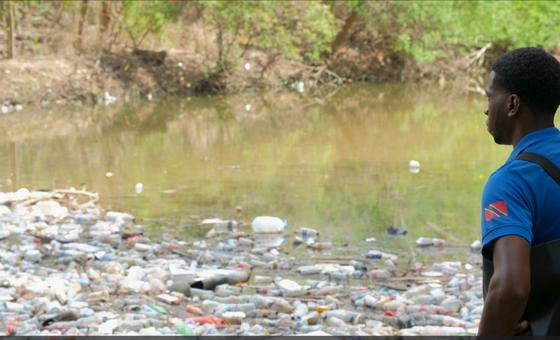
Outside of irrigation, the largest segment of human water consumption is devoted to industrial activities. The problem in terms of freshwater resources generally has less to do with the quantity of water used than with quality, i.e., wastewater which contaminates rivers, lakes and groundwater.
Although personal and urban consumption accounts for only a small fraction of total water use, sewage from these sources causes major health and ecological problems in all regions, and particularly in developing countries. In most cities in developing countries, only about 10 to 20 per cent of wastewater is treated.
According to a projection--prepared for the Food Summit in Rome--that assesses trends in agricultural, industrial, municipal and household water use, global freshwater requirements for the year 2025 will exceed by 5 per cent the 14,000 km3 of water that is accessible without tapping deep underground aquifers. If freshwater demand is not to exceed supply sometime during the next quarter of a century, improvements in conservation as well as in capacity to clean and re-use water need to be implemented.
Stresses on water and land are closely linked, the Assessment shows. Soil and water mismanagement intensifies erosion, denuding the earth of topsoil and nutrients and polluting watersheds with organic particles and silt. Eroded material may be deposited in lakes and reservoirs, gradually reducing their water storage capacity.
Irrigation of arid areas where there are inadequate drainage systems produces waterlogging and soil salinization. About 20 per cent of the world's 250 million hectares of irrigated land is salt-affected to such an extent as to reduce crop production, and an additional 1.5 million hectares are affected each year. The countries most severely affected are located predominantly in arid and semi-arid regions. Another threat caused by modern agricultural practices is the use of pesticides and chemical fertilizers, which leach into the soil, work their way into the groundwater and eventually degrade coastal areas.
Increased food production to combat malnutrition among about 800 million people and to feed a growing world population must essentially come from intensification of agriculture, rather than expansion of cultivated land, according to an analysis prepared for the Food Summit. The intensification potential of irrigated agriculture is much higher than that of rain-fed agriculture, but so are the environmental costs. Cutting-edge techniques for more efficient irrigation need to be utilized to save water and reduce negative environmental impacts. Such techniques generally require a high initial investment, according to the Assessment. But practices such as drip irrigation can reduce water use by 25 to 90 per cent while increasing crop yields by 50 to 100 per cent.
Even if agricultural production is intensified, it is expected that new areas of land will have to be brought under cultivation to meet rising food demands. According to a report of the Food and Agriculture Organization of the United Nations, 90 million hectares of land will need to be brought into cultivation by 2010, and half is likely to come from forest areas that presently conserve rainwater and protect soil from erosion.
A longstanding goal of the international community is the provision of drinking water and sanitation for all. But despite access to sanitation provided to an additional 200,000 people each day during the UN's International Drinking Water Supply and Sanitation Decade (1981-1990), gains were outstripped by population growth. The problem of inadequate water supply and sanitation needs to be addressed with demographic, economic and social aspects taken into account. Enabling access for all to safe drinking water and sanitation by 2025 means meeting the needs of an additional 5 billion people, or about 450,000 each day.
High-intensity use in urban and industrial areas may place severe stress on freshwater resources in surrounding localities. The Assessment reports an estimated household consumption in industrial countries of 150 to 200 litres of water per day, with an additional 150 to 200 litres per person per day going for various municipal services. Additional conservation measures could reduce the per capita amount of usage. But in the developing countries, it can be anticipated that current per capita usage, which is about 50 litres/person/day in many urban areas, is sure to increase in the coming years. This will necessitate additional water-treatment capacity and improved water-management capacity.
Problems related to freshwater impact most severely on low-income countries, in which three-quarters of the population must survive with a per capita income of less than $2,895. Thirty-four per cent of the population in the developing world live in countries currently under moderate to severe water stress ("moderate stress" is defined in the Assessment as human consumption of more than 20 per cent of all accessible renewable freshwater resources; "severe stress" denotes consumption greater than 40 per cent). The Assessment projects that as many as two thirds of the countries in the lower-income categories could face moderate to severe water stress by the year 2025.
Other low-income countries that are not under stress in terms of consumption as a percentage of available resources nevertheless face crises due to pollution and to a lack of institutional and technological capacity to utilize water resources within their boundaries or adjacent to them.
The proportion of people in the industrialized world who live in countries facing moderate to severe stress -- 31 per cent -- is nearly as high as in poor countries, although the richer countries have more resources available to apply to solutions. Many areas of the industrialized world already are beginning to experience constraints in economic and social development due to water problems, and Assessment scenarios project that the proportion of the population in developed countries living under conditions of moderate to severe stress on water resources could easily rise to more than half by 2025.
In short, the efficient and equitable use of freshwater resources is a condition for progress on eliminating hunger, improving health and advancing economic development. Poor people feel the effects of water shortages and polluted water more severely than the rest of humanity; conversely, action on freshwater issues is one of the key means of advancing the goal of poverty eradication that was set at the 1995 Social Summit and in other international venues.
As more than 300 major river basins and a number of the major groundwater aquifers cross national boundaries, there are ample possibilities for conflict between States, as well as within them.
But scarce water resources may also serve as a means for domestic and international cooperation. A 1995 protocol between eight Governments of the Southern African Development Community plans for equitable use of shared watercourses and an integrated water resource development programme. In Europe, the Rhine Action Plan has led to a cleaner river and rejuvenation of several species living within it; and Canada and the United States have been cooperating on sharing of the waters of the Great Lakes and the prevention of pollution since the 1909 Boundary Waters Treaty between those two countries.
In the United Nations, an international convention on the non-navigational uses of international watercourses was adopted by the General Assembly in May 1997. The convention, which will go into force when signed and ratified by 35 countries, sets out a framework for the rights and obligations of upstream and downstream riparian States, and deals with matters such as flood control, erosion, sedimentation, saltwater intrusion and protection of aquatic life.
Although most problems related to water quantity and quality issues can be addressed by national and regional actions, the authors of the Assessment maintain that anything short of a global commitment will not achieve the goal of sustainability. Intergovernmental dialogue on principles and means needs to be intensified. Investment in cost-effective technologies for the conservation and safe re-use of water needs to be stepped up, along with transfers of technology and resources to countries with a low capacity for coping with water scarcity and pollution.
Some countries will need to make a transition from trying to be food self-sufficient (capable of producing all food within their borders) to being food self-reliant (able to provide food through purchases on the international market as well as from national sources). In doing so, countries will become dependent on world market conditions. Policies need to be designed to cushion the impact of increases in the price of food on the poor, and to protect small farmers from naked competition with international agribusiness. New options for income generation for individuals and foreign exchange earnings for countries will need to be created.
Pricing mechanisms for water need to be introduced which allocate water in a way that will optimize its benefits. If the cost of using or misusing water is not paid by the user, it will be borne by the community at large. Under current conditions, the cost of water shortages paid for most dearly by the poor in developing countries, who have little access to water for sanitation and often must pay for and carry home bottled water for personal consumption. Implementation of the market pricing of water needs to be carefully managed in order not to exacerbate distortion in the allocation of water resources and cause further economic imbalance. In some cases, subsidies that will help develop water and sanitation systems and increase efficiency in agriculture and industry may be necessary, but the long-term aim should be to obtain full cost recovery in all systems.
Water monitoring and assessment capabilities are quite weak in many countries. Data on hydrological flows, water use, water quality, demography, forestry and land management need to be harmonized and made accessible. Education and partnerships with the private sector and within academia are needed to bolster research capacity.
International systems for monitoring freshwater conditions and analyzing solutions need to be matched by public opinion campaigns designed to create the broadest social consensus on the urgency of the issue. The overlapping interests of Governments and industry in terms of protection of freshwater resources should be used as the basis of private-public partnerships.
Given the lengthy period required for planning, design and construction of large-scale water projects, as well as the time required for ecosystems to recover from stress, concerted action needs to be taken immediately at the local, national and international levels, the Assessment says. Countries, working on their own, in regional groups and with international institutions such as the United Nations, need to develop a broad range of water strategies based on the best available knowledge. These include incorporating water issues into development plans and building a global trading system in which countries that lack enough water to grow their own food will have access to crops from water-rich regions.
The Comprehensive Assessment of the Freshwater Resources of the World (E/CN.17/1997/9) is available in the six official languages from the United Nations or through the web site of the Department for Policy Coordination and Sustainable Development (http://www.un.org/dpcsd).
For further information contact:
Division for Sustainable Development
Department for Policy Coordination
and Sustainable Development
United Nations
New York, NY 10017
Tel: 1-212-963-4800
Fax: 1-212-963-1795
E-mail: dpcsd@un.org
or
Development and Human Rights Section
Department of Public Information
United Nations
New York, NY 10017
Tel: 1-212-963-3771
Fax: 1-212-963-1186
E-mail: vasic@un.org